
Image via Pew Research
***
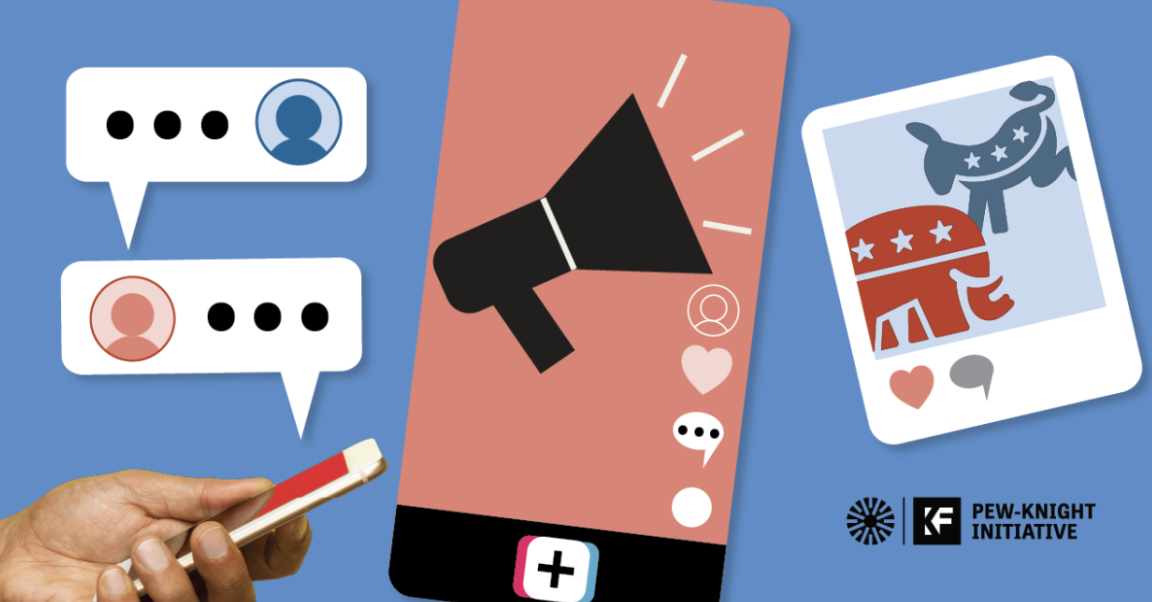
In a day and age in which social media has cemented itself as a staple to journalism and news outlets, political news outlets have adapted their content to fit in with that of pop culture. Scroll through TikTok or X for a few minutes, and it becomes difficult to distinguish which posts were made by satire accounts and which were made by official governmental accounts. The Democratic Party posts ironic edits on their social media platforms to either platform their own partisan actions or mock the opposing, as does the Republican Party.
This shift in content was not sudden, but rather a gradual curation. Political communication has been moving towards informality for years, but the rise of short form video accelerated that trend. Political content now competes in the same realm as daily entertainment, meaning it has to look and feel similar to stand out and gain outreach. Research on digital media algorithms have shown that platforms reward material that is quick, emotionally engaging, and easily shareable, while more complex information tends to stagnate. Posts provoking strong reactions—such as humor, anger, or excitement—are more likely to circulate widely than neutral or informational content, which directly affects how politicians shape their social media presences.
The response to this adaptive pressure is visible in current partisan content. The Democrats’ official pages often lean into self-aware humor, referencing trending meme templates or using viral audios. Republican content in the same space frequently emphasizes confrontation, using short clips or captions designed to promote immediate reactions and boost engagement. Both approaches follow the same underlying trend, content must feel native to the platform. Work on social media authenticity has found that users respond more positively to posts that mimic humorous trends rather than cold institutional messaging, even when they know the source is strategic.
For political parties, the appeal of this strategy is apparent. Younger audiences are far less likely to engage with traditional campaign materials, as they may come off as simply boring. Data on media consumption shows that many Gen-Z users encounter political content coincidentally while scrolling, rather than actively seeking it out, which makes passive exposure a central battleground. A meme or short video can reach users who would never watch a speech or read a policy platform. In that sense, memeification lowers the barrier to entry. It makes politics feel familiar, and in many ways, even casual.
There is also a key branding aspect in this trend. In the strategic crafting of their social media presences, parties are constructing identities and images, rather than simply communicating policies and positions. Scholars studying contemporary campaigning note that political organizations increasingly behave like brands, tailoring tone and style to specific audiences across platforms. The meme becomes part of that identity. It signals cultural awareness and humor, further aiding the parties in connecting with younger generations.
At large, this approach changes what political engagement looks like. When content is designed for speed and virality, it prioritizes viewing over deeper understanding. A meme works because it is immediately legible; it does not ask the viewer to sit with complexity. Repeated exposure to simplified, emotionally charged content has been found to narrow the range of information people engage with, reinforcing judgments rather than deep analysis. Over time, that can shape not just what people know, but how they think about politics altogether.
The tone of these posts also suggest an attempt to manage the emotional weight of the current political climate. American politics remains deeply polarized, and the public trust in institutions is low. Humor offers a way to navigate that tension. Studies on political satire suggest that irony can make contentious issues more approachable, allowing audiences to engage without feeling overwhelmed. When party accounts post memes or playful edits, they are not only chasing engagement, they are also reshaping how politics feel; less formal, less distant, and, at times, less serious.
With this shift comes risks. When politics adopts the language of entertainment, it becomes easier to treat it as something harmless to watch rather than something to actively participate in. The line between active citizen and audience begins to blur with this. Analyses of digital campaigning have raised concerns that this style of communication can reduce political issues to meaningless infographics and images, leaving less room for substantive debate. Even when the information being shared is not false, the format itself encourages simplification.
None of this means that social media is inherently detrimental to politics. These platforms have expanded access to information and created new opportunities for engagement, specifically for younger voters. The issue lies in the incentives that shape what rises to the surface. When visibility depends on virality, and virality depends on emotional immediacy, political actors adapt accordingly. The result is a feedback loop in which parties produce the kind of content that platforms reward, and users come to expect politics in that form.
The memeification of the Democrats and Republican parties is more than a simple adaptation to social media culture. Deeper lies change in how political power is pursued and understood. Campaigns are no longer confined to speeches and debates or traditional advertisements. They unfold in common sections, in edits, and posts that are designed to be screenshotted and shared. Politics still involves actual policy, negotiations, and governance, but its public image gradually resembles meaningless streams of content.
Ultimately, politics that feel immediate and accessible, yet often detached from the complexity it represents is produced. Parties speak the language of the platform they depend on, and in doing so, they reshape the expectations of the audiences they hope to reach. Campaigns now unfold through content that is fast, visually stimulating, and designed for constant circulation, shaping how voters encounter and interpret politics. While this approach has made politics more accessible, it has also encouraged a version of engagement that prioritizes viewership over depth. As parties continue to adapt to the demands of digital platforms, the way politics is presented to the public will increasingly influence how it is experienced, understood, and ultimately acted upon.
***
This article was edited by Madison Boyd.
 Glenmarie Rios Rodriguez
  Ayden Suber
  Isabella Villalobos