
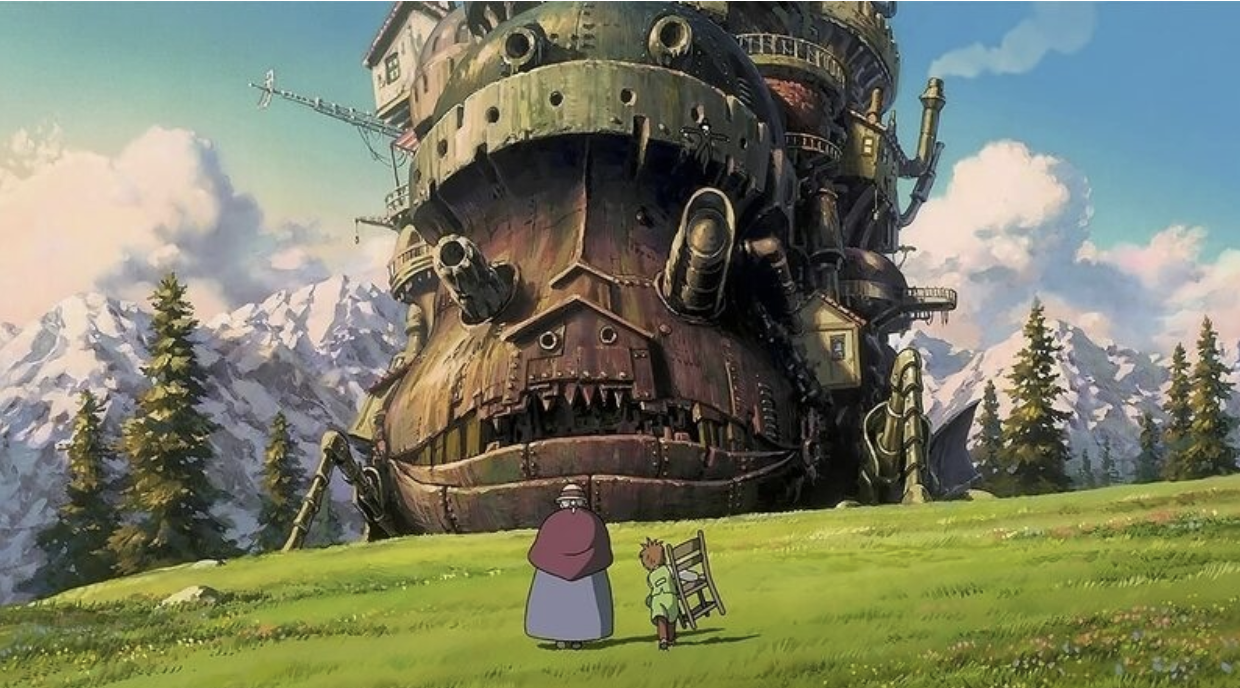
Image via Counteract
***
Film’s emulation of real world conflict and tragedy remain a source of reflection to the many downfalls of society. Time and time again, we fail to both acknowledge and learn from the past, solely allowing cycles of violence to reoccur despite who leads. Under new justifications, and new leadership, hatred prevails when it needs to the least.
Animation, especially that portrayed by Hayao Miyazaki, has often critiqued these very patterns. Though not usually acknowledged as truth, films such as those produced by Studio Ghibli remain in the realm of both escapist media and true portrayals of today’s injustices. Hayao Miyazaki’s films constantly critique the art and wrongs of war, and stand firm against its normalization, through carefully curated portrayals of anti-war sentiment.
Miyazaki’s film, Howl’s Moving Castle explores the ways in which war is often framed as inevitable, maybe even necessary, when in actuality it only prevails through the lens of political abstraction and not public will. When constituents are unaware, they lack a voice, and in lacking voice, comes many injustices—not only to us as Americans but the world as well.
Howl’s Moving Castle follows the wizard Howl Pendragon through the perspective of Sophie, a young woman cursed by an old witch into ever-lasting seniority. Set in a realm where magic allows the extraordinary to feel ordinary, the film emphasizes the importance of confidence, intimacy, compassion, and self-actualization. In spite of this, a war prevails in the background context of all that ensues amongst the main characters, Howl and Sophie.
Albeit stark, this contrast between life and war is a crucial aspect of the film itself. The war displayed throughout the duration of Howl’s Moving Castle is incredibly vague, however that decision made by Miyazaki was intentional. There is not one clear cause, enemy, nor a right or wrong to count upon. As Pendragon carries out his life as a wizard tending to the Kingdom of Ingary, the effects of this vague war are clear. People continue to suffer, buildings burn, and chaos and destruction surround. As those taking in the film, we are never given a justification for the actions that are occurring. In this absence of justification comes discomfort, chaos, and detachment from the world at hand.
Despite Howl’s role in the move, he evolves to actively resist the systems causing distress and disorder. Instead of compulsory serving the state, Howl applies his responsibility to serving and protecting the people rather than the kingdom’s political interests. Such an act of defiance presents itself as new and effective in the face of the unjust actions of war. Through this choice in character evolution, Miyazaki displays the importance of resistance in the face of power. Because then, and only, then can one reach a sense of moral clarity despite the numerous wrongs.
This film was created entirely in response to the 2003 Iraq War. The war was majorly criticized for its lack of public opinion and general justification by the government. Miyazaki has continually displayed his opposition to the war as it served no purpose but to hurt those that were powerless.
Although not directly criticized by Miyazaki, the same can be said about our current political climate and the War on Iran. Military escalation with Iran has raised questions about democratic accountability and the impact of executive power. As Donald Trump unilaterally declared war, many Americans were unable to fathom how and why such actions were able to occur. The checks and balances imposed by the first three articles of the Constitution were nowhere to be found in practice. In this vein, the parallels between Howl’s Moving Castle cannot be ignored.
Within the film, political propaganda and rhetoric pertaining to the conflict rely on abstraction. General terms relayed to the public include national security, operational necessity and defense, however there are no clear-cut reasons as to why this is occuring. Civilian harm mitigation is cast aside under the justification of military necessity, and the principles of distinction between civilian and combatants are disregarded.
While the war within the context of the movie does not end in victory nor defeat, it instead fades away. This fading is prompted by the characters regaining their humanity and rejection of politically-inclined violence. Although, there is a lack of resolution, such a choice is a mirror to reality as clear decisions and distinctions are rarely made in the political sphere.
Howl’s Moving Castle serves as both a heed and a critique on the political happenings in our world today. The justifications of war are far and few due to the distance between those declaring war, and the individuals suffering from its actions. If war is continued to be portrayed and accepted as an inevitability, humanity itself will continue to suffer at the hands of misguided and ill-intended decisions. Resultantly, the very cycles that Miyazaki attempted to expose and critique will only be perpetuated instead of terminated.
***
This article was edited by Abigail D’Angelo.
 Glenmarie Rios Rodriguez
  Ayden Suber
  Isabella Villalobos