
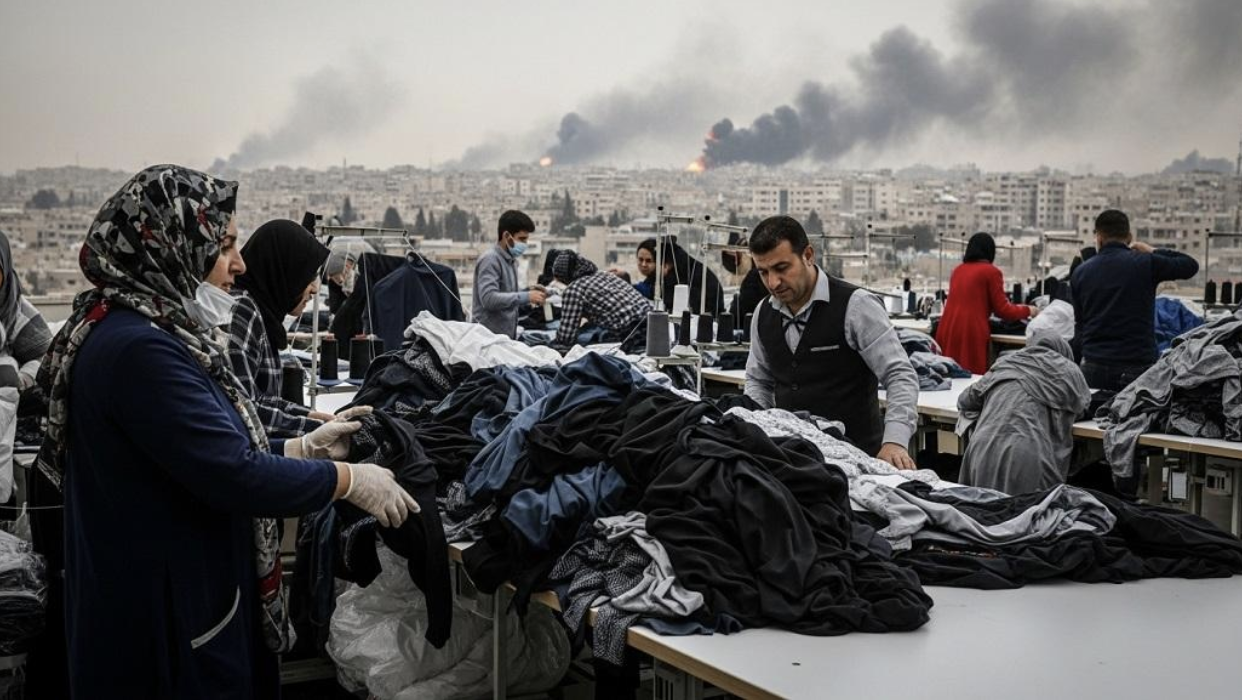
Image via Global Textile Times
***
The latest escalation in the Middle East—the U.S. and Israeli strikes on Iran, retaliatory missile attacks, and the closure of regional airspace—has rapidly transformed the region into a volatile conflict zone. Such a violent transformation comes with unavoidable global consequences.
What might initially appear to most Americans as a distant geopolitical tension is, in reality, already reshaping global industries that depend on travel stability, mobility, and consumer confidence.
Among some of the most threatened—and perhaps, to most of the public, the least expected—is the fashion and beauty industries. Long built on an image of seamless luxury and escapism, fashion is confronting the new reality that its global operations are deeply tied to the very systems now under wartime strain.
All within the past couple of weeks, the U.S. government issued a global travel warning, flights have been cancelled, airspaces in the Middle East have closed, and key transit hubs across the Gulf have faced immense disruption—signaling not only a military crisis but a full breakdown of infrastructure necessary for international movement and commerce. This is all happening just as the region is starting to become a hotbed of fashion ambition.
Industry leaders fearfully monitor the situation, acknowledging its “direct impact” on everything fashion—from store performance, to tourism, to changing consumer behavior in uncertain climates. Though long and simply perceived as insulated realms of creativity, glamour, and aspiration, the industry’s success remains dependent on geopolitical confidence. As instability festers, fashion’s reliance on seamless global operations is being tested.
Simply put, the very core of this disruption lies in the intersection of war, oil trade, and supply chains. The Middle East has long played a critical role in international shipping routes, particularly through the strait of Hormuz, where 20 million barrels of oil—20% of the entire world’s liquid petroleum—passes through daily. It is also a key route for exported goods manufactured in Bangladesh, India, Pakistan, and Sri Lanka – some of the key clothing manufacturing countries. However, with intensifying conflict, its shipping lane closures and delays cause rising costs and rerouting that prevents timely shipment of fabrics and other materials to the U.S.
These disruptions compound existing pressures from tariffs and supply chain crises. In an industry built on speed, seasonality, and precision, such delays fundamentally destabilize daily operations that once felt routine, but now require extensive contingency planning.
These effects are particularly acute in the athleticwear department, which is uniquely tied to oil markets: synthetic materials like polyester, nylon, and spandex—core components of sportswear fabrics—are derived from petroleum. Due to rising oil prices, the costs of these materials have surged, with polyethylene prices increasing by 28% and synthetic rubber by 33% since the war began. Brands like Nike and Adidas have suffered immensely, now deciding whether they should absorb these rising costs or pass them onto consumers. At the same time, high energy prices and inflation decreases consumer spending and further squeezes margins. With no clear end in sight, the ongoing tension may force brands to radically restructure their supply chains.
While athletic brands face rising material cost pressures, the luxury sector grapples with disruptions in demand, tourism, and regional growth. Surprisingly, the Middle East has emerged in recent years as one of the fastest-growing luxury markets, reporting an overall valuation of almost $13 billion in 2024 (a 6% regional growth despite a global luxury decline), and accounting for roughly 6% of global luxury sales and serving as a key growth engine amid recent stagnation in Europe. Note that while this number may seem relatively small, the luxury market is still heavily dependent on the region, with average spending on products such as watches and fine jewelry, for example, skewing much higher than other large luxury-spending regions.
This growth is mostly due to increased tourism and consumer confidence in destinations like Dubai, Riyadh, Abu Dhabi, and Doha—cities that have seen record growth in tourism in recent years and who account for the bulk of regional luxury consumption. Reportedly, brands like Dior and Gucci each get 20% of their sales, excluding beauty and multi-brand stores, from these regions.
However, air travel issues caused by Israeli and U.S. attacks have significantly reduced luxury buying activity in key airports and shopping centers. In particular, retailers in Doha’s Hamad International Airport—normally one of the busiest transit hubs in the Gulf—have been hit hard by flight suspensions and closures, resulting in an estimated loss of 10 million US dollars a minute. Additionally, Dubai’s shopping scene is dominated by two opulent centers: the Dubai Mall and Mall of the Emirates, which both house top European luxury fashion houses, and together welcome more than 140 million visitors each year. Bloomingdale’s, one of the anchor retailers at the Dubai Mall, recorded a 45% fall in visitor numbers in the first three weeks of the war compared with the same period in the previous month.
Once-thriving malls in the Middle East now remain virtually empty—showing how quickly the illusion of security can collapse under political unrest and forcing retailers into a constrained operating environment marked by muted demand. This issue has basically eliminated luxury spending in even the biggest and wealthiest cities in the Middle East.
The financial impact is already starkly visible: Just this week, LVMH, the world’s largest luxury fashion conglomerate, reported that sales in its fashion and leather goods division have fallen by 2%, with overall growth slowing to just 1% amid political unrest. Luxury demand in emerging Middle East regions—previously described as “quite profitable”—has dropped significantly, with double-digit declines in many areas.
Even in regions where operations continue, the broader uncertainty is eroding confidence, forcing brands into a precarious balancing act between optimism and risk management.
The crisis also continues to take a toll on workers, as safety concerns and security threats complicate day-to-day operations and weigh on decision-making. Sarah Hermez, an educator in Beirut, had no choice but to shut the doors of the fashion school she runs in the city in response to intense security risks. The danger faced by her students and staff is all too real, as thousands of people have already been killed across the Middle East since the latest phase of the war began on February 28.
Beyond the immediate human cost, the conflict is exposing how vulnerable global fashion has become. From high-end couture to mass-market apparel, fashion is dependent on globalized systems that are increasingly fragile. Analysts warn that if high energy prices persist, the likelihood of a global recession increases, with luxury goods among the first categories to feel the impact.
This threat raises the risk of a “fashion recession,” with industry executives in Europe and the United States saying they are worried that a prolonged war could jeopardize billions of dollars in sales.
The illusion of fashion as a stable, ever-expanding global market is giving way to a more complex reality defined by uncertainty and interdependence.
The Middle East, once seen as a reliable engine of expansion, now looks more like a source of instability than growth, with conflict, disrupted travel, and shifting consumer sentiment all threatening its appeal. Brands that have invested heavily in the region now face extreme economic volatility that can rapidly undermine their investments.
The fashion industry must therefore now enter a new era of geopolitical risk management. Creative direction and brand storytelling are no longer sufficient, and companies must now also navigate sanctions, supply chain vulnerabilities, and rapidly shifting regulatory environments.
As one industry expert warns, “U.S. companies should take proactive steps to assess and manage evolving risks tied to sanctions and terrorism financing…This includes strengthening due diligence on third-party vendors, reviewing supply chain exposure in high-risk regions and updating sanctions screening tools to account for fast-changing regulatory developments.”
The war in the Middle East ultimately demonstrates that fashion is not an isolated cultural force but a deeply interconnected global industry. Its success depends not only on aesthetics and aspiration, but on the stability of the political and economic systems that sustain it.
As those very systems come under strain, the fashion industry must confront a fundamental truth: the world of luxury is not immune to crisis—it is fully shaped by it.
***
This article was edited by Abigail D’Angelo.
 Glenmarie Rios Rodriguez
  Ayden Suber
  Isabella Villalobos