
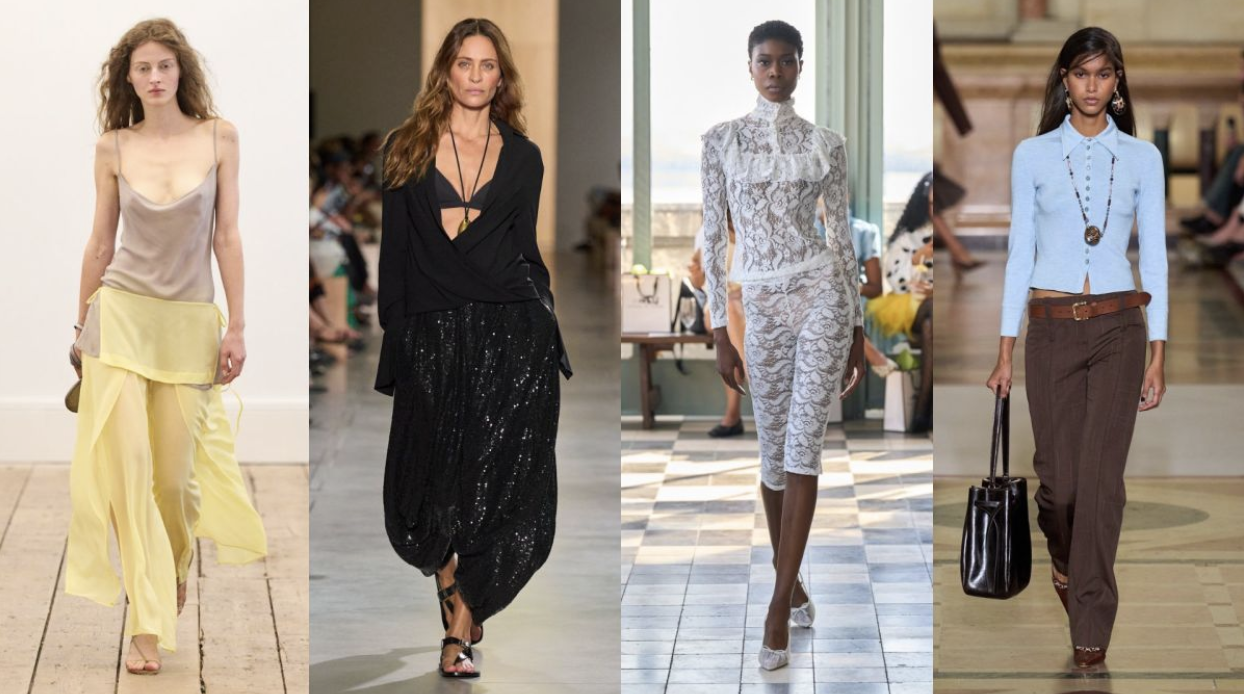
Image via Fashionista
***
New York Fashion Week Spring 2026 arrived at what Vanity Fair described as a “volatile political time,” and a “precarious” moment for American fashion. Critics and fashion enthusiasts alike watched closely, wondering whether the designers they have long admired and studied would rise up to meet the current American sociopolitical climate.
The short answer? This season, to most, felt disappointing. For a moment so defined by aggressive immigration crackdowns, mounting national polarization, and heightened cultural tension, overt political statement on the runways was shockingly sparse.
Even designers who have previously embraced activism opted instead for restraint. Collina Strada, designed by Hillary Taymour, has in the past addressed issues such as climate change, racial injustice, and social surrealism in past seasons. However, for NYFW 2026, the brand’s show focused on “shadow self” themes with models in all-black outfits, garnering criticism for superficial execution and problematic racial undertones rather than overt politics. To be fair, Collina Strada was not alone in this pivot. Across the week, a noticeable quiet prevailed.
In fact, only one designer truly stood out: Rachel Scott, founder of Diotima.
Scott’s work at Diotima consistently centers around decolonization, and rethinks the stereotypical model of “elegance” from a non-white, non-eurocentric perspective. This season, she partnered with Cuban modernist artist Wifredo Lam to create a series of “powerful heroines,” refusing the recent trend of empty messaging and intentless aesthetic.
Instead, Scott called for more action within the industry—“If you have a platform of any form, you need to be saying something about what’s happening, especially in fashion, which operates in the realm of culture,” she said, adding that she was disappointed so few colleagues addressed the ongoing concerns over democratic backsliding and aggressive immigration enforcement measures in the U.S.
Critics called her show “extraordinary and emotionally charged,” a breath of fresh air that placed fashion in “direct conversation with the social landscape of America” at the end of a “week defined by political apathy.” In a season that felt overall muted, Scott proved that fashion can be both aesthetically rigorous and politically lucid.
Elsewhere, political gestures—the few that were made—tended toward the symbolic.
Just before fashion week, retail stores across New York City closed their doors in protest of recent ICE activity, marking the first general strike since the 2020 Strike for Black Lives. However, the majority of the participating brands were small, independent businesses or boutiques, who face the greatest economic risks from a day without sales, especially in such a currently volatile economy.
Throughout the week, high-profile attendees of the shows wore “ICE OUT” pins over their couture and tailored suiting—part of an ACLU-endorsed campaign to draw attention to the increased precedence of Immigration and Customs Enforcement. These same pins had appeared slightly prior on celebrities like Justin Bieber and Billie Eilish at the Grammys. As one ACLU organizer put it, “We need every part of civil society to speak up. We need our artists. We need our entertainers.” Fashion weeks, after all, tend to “serve as a platform for attendees to make political and social statements.”
But, are lapel pins enough?
Despite these flickers of engagement, most of fashion’s biggest names—many of whom donated “tens of thousands” to Andrew Cuomo’s failed re-election campaign—avoided political commentary altogether. Few brands addressed current federal policies, even though many of those policies target key pillars of the fashion community—the LGBTQ+ community, Asian Americans, Latinos, and women.
Instead, many of these brands opted for “intimate showcases” and “delicately merchandised lines,” steering clear of spectacle and, perhaps, the expectation of activism. As far as actual design, a majority of designers played it safe, showing minimalistic collections that some are calling “upper middle class chic.”
To be fair, the hesitation from even these established brands is not entirely inexplicable. As American fashion confronts a “global luxury slowdown,” fashion appears to be undergoing a transitional period. Taking a strong political stance is always risky for brands, as it means alienating large percentages of the customer base who do not align. Taking a strong political stance now, in such a polarized climate, while facing industry instability, is even riskier. And, anyway, efforts of activism by large brands are often written off as performative or opportunistic.
However, it’s not just legacy houses that are the problem. There’s been a recent trend of young far-right designers with “an appetite for taboo as texture,” and an appetite for testing boundaries.
But most have not committed as hard as Elena Velez. Dubbed “the Donald Trump of emerging designers” and “fashion’s problematic fave,” Velez has built her career on weaponizing spectacle and outrage.
She recently captioned a photo of herself in her own designs on social media as “The ICE agents who escort you to your crystal hereticon apocalypse ball” before attending the New York Young Republicans Gala.
In the past, she has received major backlash for runway stunts such as casting Anna Delvey—elitist convicted fraudster—to open one of her shows in an ankle monitor. Her Fall 2024 collection, inspired by “Gone With the Wind,” was accused of romanticising racist antebellum aesthetics. In response, Velez defended her brand as “post-woke,” and framed dissent as the only remaining form of punk in today’s society.
“We live in a time when everything is possible and nothing is allowed,” said Velez. Apparently, rubbing against “sensitive walls” is the “point.”
This New York Fashion Week, Velez debuted her Fall 2026 Ready-to-Wear line, titled “MANUS MAXXIMA,” which is Latin for “the greatest hand”—positioning itself as an exploration of self-obsession and transhuman vanity. Her designs were, as expected, not outstanding (distressed knits, unhinged hems, unfinished cut-out skirts—boarding into something closer to a senior thesis presentation), but what grabbed the public’s attention was her grand finale.
Velez decided that as fashion goes digital, she would focus on “the most compelling and iconoclastic voices of this moment in time”, and chose misogynist, “right-wing-adjacent, looksmaxxing livestream paragon” and TikTok personality “Clavicular” to close the show—while he livestreamed it—wearing a latex and liquid silicone-coated shirt he called a “cumbrella.”
Although, he’s “really not too sure. [he doesn’t] know anything about fashion.”
According to commentators, casting him was a deliberate, “plainly edgelord provocation,” ultimately legitimizing and platforming “a figure whose online orbit reeks of racism and far-right affiliations.”
Evidently, Elena does not care about the fashion industry, at least, not nearly as much as she cares about manufacturing a viral moment.
And, despite her inflammatory cultural positioning, Velez has been repeatedly awarded by the establishment, winning American Emerging Designer of the Year in 2022, joining the CFDA in 2023, and becoming a semi-finalist for the 2024 LVMH Prize.
Not all designers who avoided political commentary this season were so overt in courting controversy, but there was a perceptible shift—the fashion industry appears disinterested in making a statement, and even less concerned with the implications of provocative, or even offensive, ones.
Yet, history suggests that fashion has rarely been so detached or apolitical.
In ancient Greece and Rome, specific garments were used to symbolize democratic participation and citizenship status. In the French revolution, the tricolor cockade signaled allegiance to the people, while aristocratic dress became a symbol of excess and betrayal—think Marie Antoinette’s controversial extravagance. In more recent decades, the miniskirt became a marker of rebellion within the feminist movement, and Civil Rights activists like Rosa Parks dressed in impeccably tailored clothing in order to gain respect and dismantle racist perceptions of black people being “unprofessional.” Even recent elections saw candidates like Kamala Harris adopt suffragette purple to invoke democratic lineage.
Needless to say, fashion has long functioned as cultural shorthand – reinforcing or dismantling class, race, and gender divisions.
So, then, why does 2026 feel so quiet?
This silence from the fashion industry doesn’t seem to make sense, considering buyers increasingly seek out the companies that align with their personal morals, with 71% of consumers saying any particular brand “must take a political position.” Furthermore, 51% of consumers assume that when a brand fails to transparently communicate their stance or actions regarding social issues, they are “doing nothing or hiding something.”
The heightened tension between risk and responsibility, and sincerity and strategy, defined New York’s most recent fashion week.
It is true that fashion is undeniably capitalistic—dollars matter—but as scholars and designers alike have argued, fashion is, and always has been, a bold dialogue, a cultural shorthand in which justice is expressed.
But lately, the runways feel cautious. Small lapel pins have replaced real action. Silence has replaced solidarity. Restraint has replaced conviction.
Some say that they just “don’t think fashion is there anymore,” at least not in the way it once was.
The blueprint has always existed. We know that the question is not whether fashion can be political—history has answered that.
The question now is whether fashion will meet the moment. Or whether, in its silence and spectacle, it already has.
***
This article was edited by Abigail D’Angelo.
 Glenmarie Rios Rodriguez
  Ayden Suber
  Isabella Villalobos