
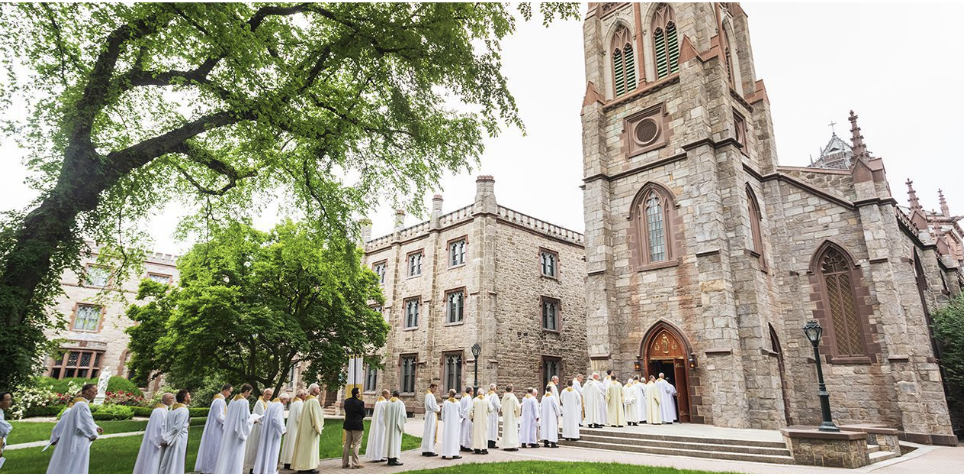
Photo via JesuitEast
***
If you walk onto the campus of Fordham University, Georgetown University, or Boston College, you will find coffee shops, competitive sports teams, busy libraries, and pre-law posters galore. What you are less likely to find, increasingly so, is a Jesuit.
The Society of Jesuit, founded by St. Ignatius of Loyola in 1540, built its educational philosophy around cura personalis, magis, and people for others. For nearly five centuries, these principles have shaped the mission of Jesuit universities.
Today, that mission is quietly competing with the needs of a growing number of students and their desire to get ahead in their careers. Jesuit Universities are also trying to adapt to the generation that is, by every measurable standard, the least religious in American history.
The United States has 27 Jesuit colleges and universities, which together enroll hundreds of thousands of students. These are not small, quiet places of learning. They are research universities that want dedicated and passionate students, so they market themselves that way.
This growth didn’t happen all at once. However, many people point to the Land O’Lakes Statement of 1967 as the turning point. In this statement, a group of Catholic university presidents, many of whom were Jesuits, said that Catholic universities must have “a true autonomy of academic freedom in the face of authority of every kind.” In practice, this meant moving governance away from the Church. Lay boards replaced religious boards, crucifixes were taken down from classroom walls, and the phrase “in the Jesuit tradition” quietly took the place of what had once been a living, active presence.
There has never been a moment in history when youth have denounced religion in the way they are now. A Gallup poll from 2025 found that about 34% of Gen Z does not identify as religious. For adults between the ages of 18 and 29, that number rises to 38%. The Survey Center on American Life says that Gen Z is the “least religious generation” in American history. These demographics are part of what makes these questions so important.
These are the students filling the lecture halls at Jesuit universities. They are not necessarily choosing Fordham or Georgetown because of Ignatius of Loyola. They are choosing them because of the U.S. News rankings, proximity to New York or Washington, D.C., and the strength of their finance and pre-law programs. Jesuit schools are explicitly open to students of all faiths and none at all. However, inclusion and secularization are not the same thing. The line between being open to unbelievers while also having nothing left to offer them in terms of spirituality is getting thinner and thinner. The conflict between the Jesuit mission and pre-professional aspiration is not theoretical. The way these schools market themselves has changed noticeably. Instead of talking about things that sound like “magis” or “solidarity with the poor,” they now talk about starting salaries, bar passage rates, and medical school acceptances.
This is not to say that the Jesuit values have entirely disappeared. Some institutions are making genuine efforts. Gonzaga University updated its Statement of Affirmation in 2024, articulating a commitment to the “dignity of the human person, social justice, diversity, and solidarity with the poor and vulnerable.”
However, the International Association of Jesuit Universities itself acknowledged at a 2024 gathering in Rome that there is an ongoing and unresolved question at the heart of Jesuit higher education: is the university apostolate of the Jesuits still possible? People within these institutions are asking these questions because the distinct characteristics of Jesuit education have changed so drastically over time.
Universities are not just places to get degrees. They mold the values, civic behaviors, and moral creativity of generations. The Jesuit model, which is based on reflection, service, and caring for the whole person, was made to fight the idea that education is only for getting ahead in your career. At a time when almost a quarter of Gen Z thinks that religion does more harm than good, the case for schools that offer an alternative to purely transactional education is arguably stronger, not weaker. The Jesuit mission does not require that students be Catholic; but it does require that institutions be willing to ask students to think critically. This even means asking institutions in hiring, how they use their money, and what they celebrate as success.
Fordham is known as “the Jesuit University of New York.” Fordham and every other school that follows this tradition should ask themselves if that is still a description or if it has quietly become a slogan.
***
This article was edited by Emma Zadrima and Margot Sleeman.
 Glenmarie Rios Rodriguez
  Ayden Suber
  Isabella Villalobos