
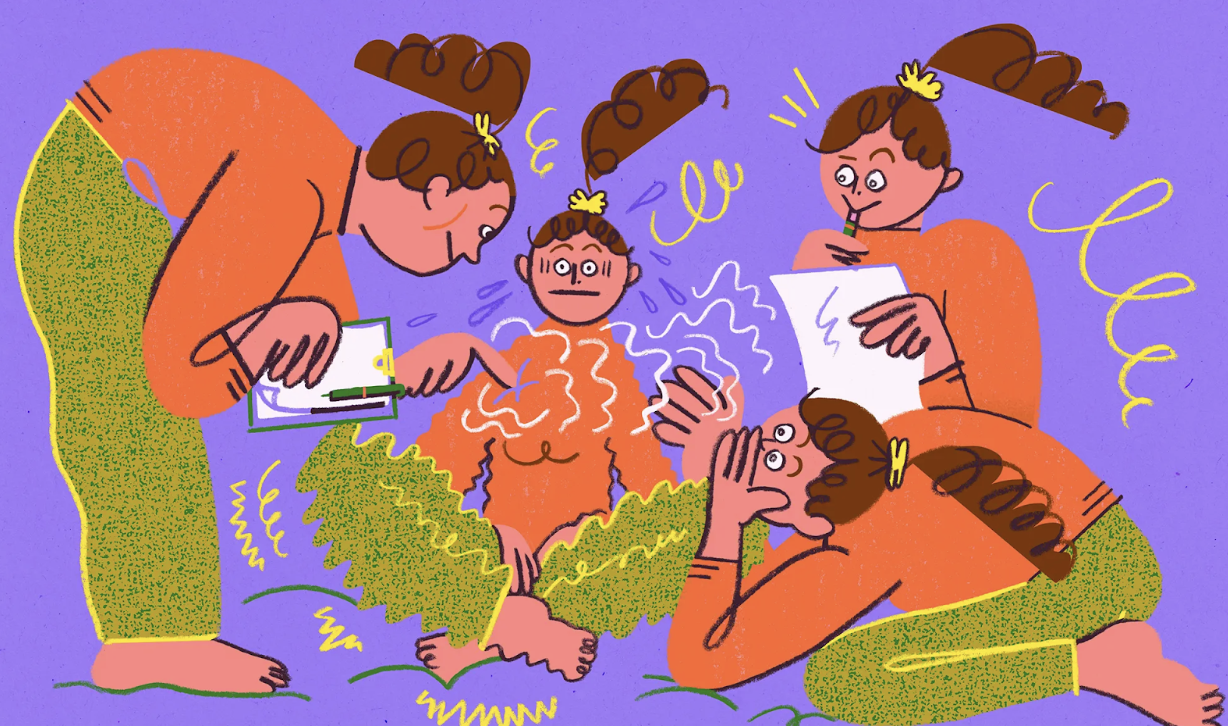
Image via Kati Szilágyi
***
When your performance on an exam is unveiled on Blackboard is there a sigh of relief? The unknown becomes known and you no longer have to wonder. The education system’s organizations set the background for the color coordination of your academic organization. Much of American education corresponds to the internal organization of the capitalist workforce in its structures and values. Samuel Bowles and Herbert Gintis made this groundbreaking claim in their 1976 book, Schooling in Capitalist America: Educational Reform and the Contradictions of Economic Life. Despite the fact that it was written 50 years ago, the systemic issue remains. This leads us to the question: how can this process be embraced from a student perspective? Although grades function as a form of economic conditioning within education, students can resist this system by cultivating relationships that re-center learning around curiosity.
Bowles and Gintis were heavily critiqued for their Marxist influences portrayed in their book; however, I believe their understanding of the education system is astute. They coined the “correspondence principle” which presents the concept that American schooling mirrors the workplace in its hierarchy and external awards. The educational hierarchy rewards obedience through the teacher-student relationship which Gintis and Bowles believe, reflects the relationship between a workforce and manager. In the 70s wearing uniforms and discipline were promoted among students from lower socioeconomic backgrounds, similarly to lower-level employees. This hierarchy leads to obedience in classrooms that continues systemic poverty. What drives this compliance and hierarchy in classrooms is the external reward: grades. The letter scales are a representation of aptitude for future employers. Hence, why we add our GPA to resumes and college applications, not only are they data on our ability to analyze and reproduce information, but the obedience we exhibited in order to do so. In this sense, grades begin to function less as measures of learning and more as a kind of educational currency—one that conditions students to equate performance with compensation, much like wages in the labor market.
Furthermore, grades function as economic incentives in the classroom, parallel to wages in the labor market. When comparing monetary academic rewards and grade rewards, a study in 2023 demonstrated that while monetary rewards can boost short-term performance, they don’t produce lasting improvement. On the other hand, grades function as a more enduring incentive—especially for conscientious students who are more responsive to structured evaluation. This proves grades operate like a form of economic incentive within education, shaping behavior over time not just by rewarding outcomes, but by reinforcing disciplined habits.
In high school, grades created a competitive environment. Oftentimes students who were raised in socioeconomic environments to crave a college education are financially pushed to the top of the class due to their access to resources outside of the classroom. While grades seem fair at this level of education, their outcomes are shaped by socioeconomic status. The competitive traits of the American high school experience lends itself to the cutthroat environment of the modern job market. This domain has created a shift from collective learning to market competition which has only been accelerated by the technology that Bowles and Gintis lacked the opportunity to consider.
The gradebook immediacy of the modern world furthers the capitalistic principles driving education standards. Blackboard, Canvas, and Gradescope all positively increase our communication with instructors, but simultaneously claim students’ attention in a format unseen before. In the days following an econ exam, I find myself checking my grades prior to responding to my parents’ text messages. I crave the sanity of just knowing where my grade stands and how the hour of equations will impact my future. Instead of responding to the people who care about me, I am prioritizing my incentives to success. Are grade obsessions in students a Darwinian evolution of the learning process?
If the focus is, what can I do for an A rather than, do I understand how to effectively apply this information the education system is systemically failing the students. Since 2022 students have employed AI precisely for this furthering the gap from genuine comprehension and blind actions toward a grade. With this application of AI the educational system will begin to lose the curiosity which has historically driven it. On the other hand, AI-powered platforms can democratize education, making it more accessible, equitable, and adaptable. It is critically important to consider that not all learners have equitable access to technology. At Fordham, this raises a broader institutional question: whether universities will reinforce grade-driven performance through tighter surveillance and control, or instead reorient toward cultivating curiosity, and equitable access in an AI-shaped academic landscape. As seen this semester, the majority of midterm essays and exams were in blue books because of AI prevalence. In this sense, AI is not disrupting the system of education instead, it is revealing how deeply it has always been rooted in performance over understanding
Beyond the technologies which have accelerated the capitalistic characteristics of education I believe students are morally obligated to develop a relationship with their educators in order to game the system and further their own education in a form that is propelled by shared curiosity and care. We are proven to learn better when we have an individual relationship with an educator.
This is the employment of care ethics at its most core value. Care ethics is an ethical theory developed by Carol Gilligan in the early 1980s. It is built on the subjective and maternal practice of care toward dependents. The mother’s instinct is inherently partial to the safety and well-being of the child. Care ethics emphasizes empathy and responsiveness to needs over abstract rules. Think of a mother walking in the subway with a young child. Suddenly, a man wearing a hoodie walks between her and the kid. Rather than asking what he is doing, her instinct is to push him away and reach for the child in order to protect them. Do you think it is morally wrong for her to do so? The mother’s protective instinct for her child ruled over the abstract rules of communication prior to physical action.
Nel Nodding wrote a book about the application of care ethics on pedagogical processes called Caring: A relational approach to Ethics and Moral Education (2003). Its most central claim is that moral education should teach caring through teacher demonstration, dialog, and practice caring for fellow students. This was later built on by Paulien C. Meijer, author of Supporting presence in teacher education: The connection between the personal and professional aspects of teaching (2009). This journal examined Jeff, a 24-year-old teacher, over the course of a year as he improved on his ability to teach by developing a more active presence. The conclusion of the journal is that teaching effectively is a deeply personal process for both the student and professional. From a kindergarten teacher explaining why we can’t hit each other, to a philosophy professor presenting the trolley problem. Our inner codes create our ethical interactions with reality and are developed through our education. I believe, as a student, that our understanding of our professors’ perspectives warp our ability to effectively internalize and apply the information they are sharing.
At Fordham, the emphasis on cura personalis (care for the whole person) presents a direct contradiction to the grade-centered structure that dominates student life. We are told that education here is meant to develop us intellectually, morally, and spiritually, yet so much of our daily academic experience is reduced to numerical evaluation and performance metrics. I have found that the moments where I actually feel aligned with Fordham’s mission are not when I receive a grade, but when I am in conversation with a professor after class or during office hours. In these interactions education feels less like a transaction and more like a relationship.
In my own experience this semester, the classes that have impacted me most are not the ones where I was most concerned with my grade, but the ones where I felt seen by my professor as an individual thinker. That recognition shifts my motivation entirely. I am no longer working for an A, but for the sake of contributing to a shared intellectual space. This is where I believe students have the most agency within a system we cannot fully control.
I am committed to the idea that the only appropriate response to the capitalism of the education system is to take advantage of the relationships it offers on a smaller scale to promote slow change in students’ approach to their educators and institutions. While these micro relationships may not have a massive effect on the system capitalism of the education system, they play a critical role in our interpretations and understanding of information fed to us. I believe that if we continue to allow the capitalism of grades to define our education, we will neglect the relationships that have historically been the fountainhead of its progress. So use this as an excuse to attend office hours before the semester ends and ask your professors why they teach what they do, and what drives their passion for the subject, as an act of protest toward the system evaluations that feed the labor force.
***
This article was edited by Emma Zadrima and Margot Sleeman.
 Glenmarie Rios Rodriguez
  Sarah Olivia Sullivan
  Luke Helmholz