
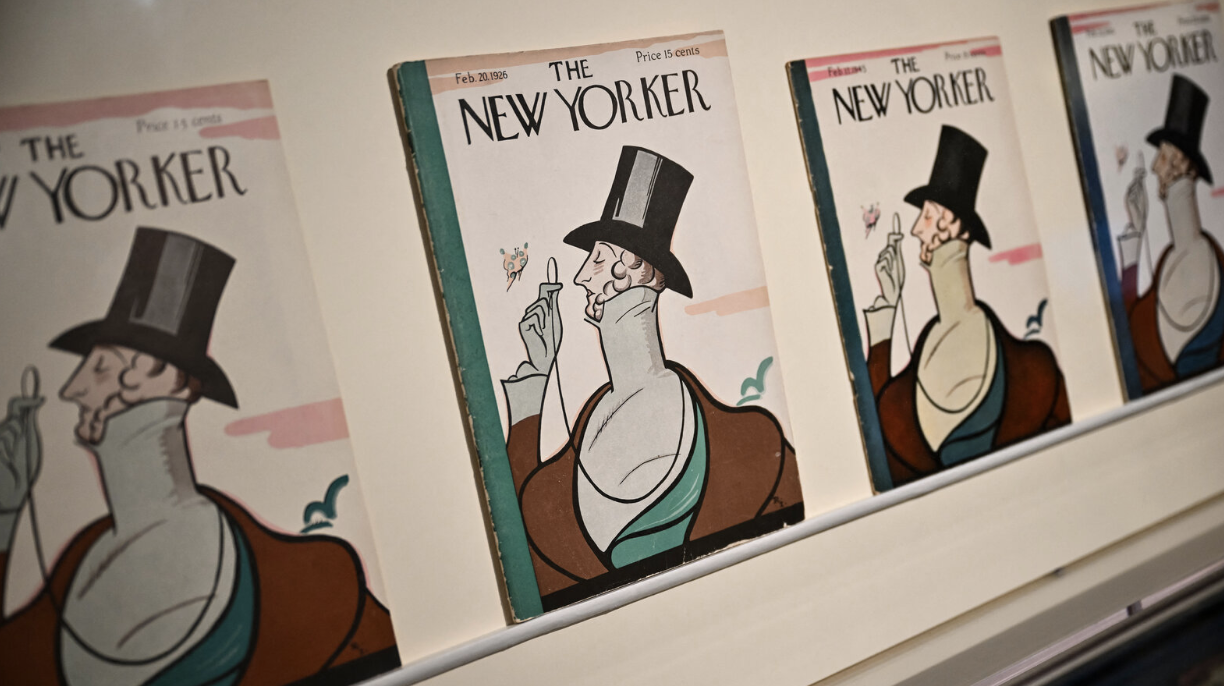
Photo via New York Times
***
Would you like to slow down? No thanks—I am from New York. I am always in a rush. Busy, busy bustling bee. From networking to pilates class to mushroom-hunting- discovering-the-secret-nature-in-Central Park, one always has too much to do here. Stillness feels lazy. You have to prove yourself: to others, to the city and to yourself; as if to make sure you are intense enough to belong here and to the city
There’s always somewhere to be, someone to meet, oh and I don’t drive there, I commute. I don’t know how to drive, actually. Did you know New York is the only city in America where public transport is the primary way people get to work? Yeah, the subway is our community.
Did this caricature sound slightly obnoxious, yet ever so personal, with a mixture of pride and ridicule? That’s because for better or worse—it’s true. New Yorkers do have a distinct sense of identity. One that puts the city above the country, a country that is already known for being loud about its sense of identity.
Indeed, New York seems to claim its identity not by belonging to a particular group but by sharing a system of cultural codes. You belong through non-belonging. People with various backgrounds, aspirations and socio-economic statuses are equally part of the city. As opposed to many other American cities where a native would would be measured by heritage and the amount of time spent in the area, a New Yorker is more of a mindset and lifestyle than longevity.
So what makes someone a true New Yorker then? As always with identity, the issue is multilayered, contextual and personal. Nevertheless certain patterns do become apparent. The sense of rush, hustling culture and obsession with productivity certainly plays a significant role.
The concern with productivity can easily be explainable due to the exorbitant cost of living, as indeed New York ranks 7th in the most expensive cities in the world. One has to earn good money to live well here. However, there is more to it. It is a city for busy people, for people with a dream. To do well here, money is not the sole prerequisite. Most good things happen through knowing the right person. From free broadway tickets, to private parties to a Lebanese restaurant recommendation, the city is a web of word of mouth. This gives the city its community feeling but also its coarse nature.
People are not friendly, but they help each other out. Not in the conventional sense of small talk and easy smile, but they show up when it matters. In a metropolis of this size, it is impossible to notice and commit to every person in distress, but it is possible to be there for one’s community.
The beauty and pain is that no one cares. One could be wearing the most extravagant clothes, sharing news about a prestigious employment or blatantly screaming, people move on with their day. Sometimes this leads to the feeling of invisibility, or insignificance as no matter how much you do, there will always be someone who does more. Yet in the end, this insignificance is also freeing. A city where something happens all the time, inevitably cures the fear of missing out. New York is a self contained universe. Within the five boroughs, one could travel the world without stepping off the subway line. With so many nations having its neighborhood, there is no unified American identity but a mosaic of micro-worlds layered onto one another: Chinatown dissolving into Little Italy, Caribbean storefronts giving way to Eastern European bakeries, West African markets coexisting with Korean delis. This then becomes the New Yorker version of American identity. These worlds are not isolated enclaves. They bleed into one another, by blending cuisines, shifting between languages mid-sentence, where identities, like streets, embody fluidity.
Then there are the institutions from wall street to broad to Times Square, those places are known in almost all corners of the world. For many, they are the entry points into imagining New York, the shorthand through which the city is labeled as the capital of the world. Yet for those who live within it, they are only fragments of a much larger whole. They may define New York’s global presence, but they do not exhaust its identity. The proximity to pop stars and the most influential people in the world, reminds others that they are indeed just people. And in a way, we are all in the same boat. Of course the rampant inequalities should not be ignored, as for some to boat is a luxury two story yacht while for others its a handmade barque with holes, nonetheless the waves are the same. The same subway line that goes through the financial district also goes to the Bronx, forcing a myriad of people to interact with each other.
The immigrant experience can not be separated from New York. A city built by immigrants, New York is perhaps the birthplace of the American dream. The dream that if you come here with nothing, but work hard, you will eventually make it. A dream that seemed to disappoint everywhere else, as inequality, foreign antagonism, and discrimination erupt barriers for people to make it. Yet New York continues to attract people from all over the world. And it is precisely this dynamic that sustains the city. People know they will be surrounded by their own kind. Not at all from their background, but from the fact that people here come to do something. They will not be alone in being displaced from their roots, because everyone else has too. Since 2020, the City’s immigrant population has rebounded, reaching 3.1 million in 2023, with immigrant New Yorkers now accounting for 38 percent of the total population, showcasing that despite a hostile administration, people still want to be here.
Indeed, seventy percent of New Yorkers say that they are happy that they live in New York while 30% say that they wish they lived somewhere else according to a new survey of New York residents released today from the Siena College Research Institute (SCRI).
So despite the living cost, the horrid weather and demanding work ethic, people are proud to belong. The bodegas, public spaces, subway, bagels, fire escapes, constant events—these are the bricks that build New York’s identity. But the rats, the not-so- pleasant smells, and homelessness are also New York. The good, the bad and the antarctic weather in April (the author’s personal grudge), make up a New Yorker’s identity. A New Yorker does not sugarcoat, leading to this tough, witty, and seen it all persona that we both love and make fun of.
To be a New Yorker, then, is to absorb all of it: the beauty and the grime, the exhilaration and the exhaustion and to carry it with a kind of defiant humor. There is no impulse to sugarcoat. Accepting that life won’t be easy and oftentimes won’t be pleasant but that we will meet all sorts of people along the way and that the city’s lights might one day light up our dreams.
***
This article was edited by Abigail D’Angelo.
 Glenmarie Rios Rodriguez
  Sarah Olivia Sullivan
  Luke Helmholz