
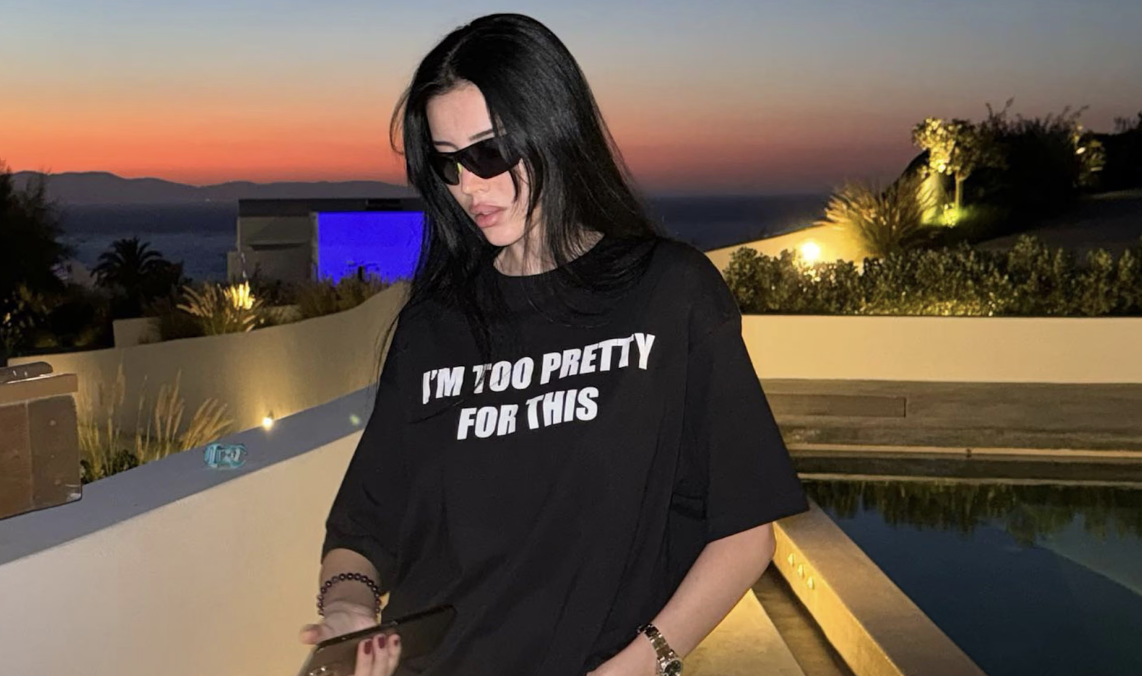
Photo via The Guardian
***
By nature, women are receivers, men are givers; and it is our job as women to place nature back in order. At least that’s what YouTube creator SheraSeven shares in her 2016 YouTube video titled “How to Get Your Man to Give You Money.” The comments flood with “I love you Shera,” “You are absolutely correct,” and “You are a literal genius.” Yet beneath this is an irony: a new facade of women empowerment built on the same traditional norms feminism sought to dismantle. This is the femosphere, a growing online community of women preaching “dark feminism,” “soft life,” and “high value femininity.”
Similar to the manosphere, the femosphere thrives on fear, resentment, vulnerability, and the illusion of self-love. Creators in the femosphere offer a false confidence that centers masculinity, preaching independence while defining womanhood and femininity in relation to men. This phenomenon reflects the “digital hall of mirrors,” where the fears and anxieties of both men and women are refracted back at each other through digital reactionary politics. Just as the manosphere radicalizes vulnerable young men, the femosphere distorts feminist language to justify submission, manipulation, and materialism. Referred to as the “pink pill philosophy,” it is the female mirror of the “red pill” ideology that is centered and embraced in the manosphere. Though these ideologies seem to be promising truth to their followers, they are coincidentally creating an atmosphere of criticism in society and in oneself.
To understand the femosphere, one must first explore its predecessor and mirror: the manosphere. The manosphere, in essence, promotes male supremacy. The United Nations defines it as an umbrella term for online communities that have “promoted narrow and aggressive definitions of what it means to be a man.” It includes online sub-communities, such as: “pick-up artists,” the Men Going Their Own Way Movement, “incels,” and “hustle bros” These online spaces date back to the early 2000s, with roots in the changing global economy, increases in gender equality with changes in gender norms, and increases in men’s mental health problems. With these dramatic changes, men experiencing alienation, loneliness, and insecurity found community in the manosphere, a space that blindly agreed with their assertions.
The manosphere is rooted in what is described as “aggrieved entitlement:” a resentment caused by feelings that one’s privileges and power have been unjustly taken away. Many men drawn to extremist or misogynist online spaces share a sense of humiliation and shame, feelings that make them vulnerable to ideologies promising belonging and restoration. Members of these online communities then blame their problems on women, distorting feminism as a scapegoat. With the increased usage of technology for leisure and emotional escape, social media algorithms further intensify these emotions through the cultivation of echo chambers that reinforce and radicalize members. This grave of echo chambers and reinforced misogyny and extremism is also known as “red pilling” and “black pilling” by researchers. Of course, the dangers of the manosphere lie in its normalization of misogyny and sexism as well as its encouragement of violence against women. In this way, the manosphere is not simply a space for men to express themselves freely, but a venue for extreme propaganda and a breeding ground for false empowerment with its emphasis on performance and hatred.
The femosphere, in turn, has spawned in reaction, mirroring the manosphere in effect. Referred to as “dark feminism,” the femosphere rebrands patriarchal values under the guise of female empowerment. The femosphere emphasizes the “pink pill,” a philosophy that claims to reveal hidden truths about men and relationships while promoting binary, heteronormative ideals. Content creators such as SheraSeven and Thewizardliz exemplify these ideas. For instance, SheraSeven, a creator with over 1 million followers, teaches women to emotionally manipulate men and “to trigger men back into their natural roles” as givers and providers. In addition, Thewizardliz, a content creator who has amassed over 8.5 million followers, criticizes women who “spoil men,” framing male-female relationships as predetermined conveniences rather than human partnerships. Although the two attempt to employ teachings on self-worth and respect, it fundamentally centers men and women as valuable or invaluable based on their financial and social merits.
Just as the manosphere radicalizes men, the femosphere radicalizes women. For instance, the subreddit group r/FemaleDatingStrategy, part of the femosphere, preaches self-worth and independence while promoting “essentialist and misandrist” discourse. The subreddit group defines gender relations through binary and polarizing views, depicting men as predatory and women as superior through an “us vs. them” pattern of thinking. This mirrors the manosphere’s ambivalent view of women as deceitful and inferior. In the manosphere, the pick-up artist community exists, with the purpose of teaching heterosexual men how to seduce women. Pick-up artist discourse relies on coded, pseudo-scientific terminology, such as “neg,” “HB9,” and “kino.” This language removes the emotional nature of online interactions and places women as objects with a “technical” procedure. Through this, women are conveyed as obstacles, goals, or data points, making cross-gender interactions to become tactical rather than natural. In addition, pick-up artist communities normalize radicalization while intentionally producing an imbalance of power at the start of conversations, with scripted emotional withholding and false scarcity to negatively affect women’s self-perception. Subreddit groups involving incels, in turn, codify their personhood by their sexual value while subordinating women to a position that situates them as manipulators rather than autonomous individuals. In the manosphere, women center the conversation, and in the femosphere, men center the conversation. In both atmospheres, members of the groups reinforce the misogynistic and patriarchal foundations of their community’s founding. Both negate and mirror each other’s supposed beliefs in order to compartmentalize the other. In reaction, this mirroring divides the communal relation between men and women. The mutual rigid boxing does not produce better relationships or perceptions, but instead erases one’s humanity and personal existence.
While toxic masculinity has been studied and critiqued, toxic femininity remains underresearched, partly because of its less immediately threatening nature. In Basu’s article, she discusses how femosphere communities are perceived as less dangerous than the manosphere because of its absence of physical violence. This contrasts with the documented history of violence within manosphere communities. Incel communities, in particular, have been linked to mass shootings and targeted violence against women, sparking concerns about radicalization, toxic masculinity, and public safety. The 2024 Isla Vista shooting, carried out by Elliot Rodger where six people were killed in a stabbing and shooting spree, exemplifies the extreme consequences of toxic masculinity and radicalization. Rodger’s manifesto, degraded in misogynistic entitlement and extreme resentment toward women, has since become a pivotal moment in discussions about the real-world dangers of extremist, male-dominated communities. However, this way of thinking overlooks the significant psychological and social harm perpetuated by toxic femininity. Though it may not manifest in physical violence, toxic femininity reproduces essentialist gender norms and weaponizes emotional manipulation. Moreover, its emergence is inseparable from the structural and interpersonal forces that shape women’s lives. Toxic femininity develops as a result of sustained experiences of misogyny, gender-based violence, and systemic inequality that structure women’s perception of power, relationships, and safety. Acknowledging the femosphere’s nuances highlights a complex dynamic in how marginalized communities can internalize and reproduce harmful ideologies in an attempt to regain agency. In this sense, toxic femininity becomes both a resistance of the patriarchy and the regurgitation of its logic.
Ultimately, the rise of the femosphere forces the realization that toxic gender ideologies are not only present in the domain of men. Although the manosphere has been recognized for its rampant misogyny and radicalization, the femosphere showcases how similar roots of essentialism, manipulation, and fear can re-emerge under myths of empowerment. Both spaces promise clarity by dehumanizing people and distorting gendered realities. And both, despite their opposition, operate and depend on the same belief that men and women exist in perpetual conflict. Nonetheless, treating the femosphere and the manosphere as mirrors raises questions about whether their parallels reflect shared origins or shared consequences. Although both spaces employ essentialist narratives on gender and promise security through fixed roles, the forces that provoke each sphere are not absolutely identical. The manosphere is often linked to declining male privilege with increased gender equality, insecurity and loneliness, and the politicization of male grievance, whereas the femosphere exerts itself within the context of women navigating misogyny, harassment, political anxiety, and renewed social expectations around femininity. These differences suggest that, although both communities produce toxic gender dynamics and politics, it may occur due to distinct reasons, complicating assumptions on the mirrored relationship between the femosphere and manosphere.
The digital “hall of mirrors” reflects a culture where gender tensions, loneliness, and political anxiety are refracted into simplistic stories of winners and losers. In this environment, communities in the manosphere and femosphere thrive because they offer a sense of absoluteness and certainty, certainty about who is to be blamed, who is owed, who is superior, and who must submit. But these come at the cost of losing empathy, humanity, and nuance. This reveals that reactionary gender politics do not simply exist in opposite spheres, rather, they sustain each other. They recreate and rejuvenate the same hierarchies, the same false promises, and the same dehumanization. If the manosphere and femosphere are mirrors, then neither truly offers a way forward. The optimal path lies in rejecting the binary and grounding spaces that do not rely on fear, insecurity, and hierarchy to define identity and community.
***
This article was edited by Abigail D’Angelo.
 Glenmarie Rios Rodriguez
  Sarah Olivia Sullivan
  Luke Helmholz