
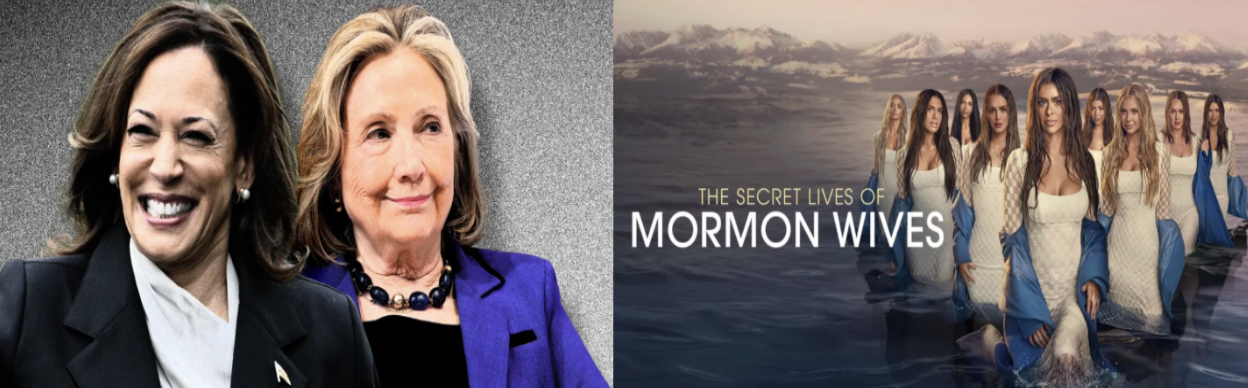
Image via New York Magazine/Whats on Disney Plus
***
If you’re anything like me, the last month of your life has been consumed by “Momtok,” a group of women known for their popular TikToks, Mormon upbringings, and reality show The Secret Lives of Mormon Wives. Like any reality television show, The Secret Lives of Mormon Wives is chock-full of petty drama, glitz and glamor, and personal struggles. However, this show adds another dimension to all of this: Mormonism. Centering around a group of Utah women who were raised Mormon, The Secret Lives of Mormon Wives flips the gender script, showcasing the dynamics of Mormon families in which the wife is the main breadwinner, leading to pushback, growth, and confusion as these women defy the gender norms of the Mormon church and pave their own paths in life. As the women of “MomTok” find success, their families, husbands, and even themselves struggle with how to balance this “role reversal” and the deep-seated sexism and sexist ideals that are prevalent in not only the Mormon church but the United States as a whole. A reality television show produced for entertainment, such as The Secret Lives of Mormon Wives, does more than simply give viewers something to do on the weekends; it highlights deeper trends in American society as a whole, unintentionally providing insight into broader cultural perspectives and phenomena, such as the United States’ inability to elect a female president.
Looking back over the last 10 years, which have seen three US presidential elections, two of them have featured a female candidate as the Democratic nominee in the general election. In 2016, Secretary of State Hillary Clinton was on the ballot, followed by Vice President Kamala Harris in 2024. In both of these elections, President Donald Trump was the Republican nominee and was declared the winner, leaving Americans to face the reality that across 47 presidencies, we have yet to elect a female president. As with everything political, innumerable factors lead to these outcomes; however, when looking at America’s history of gender norms and sexism, it would be remiss to overlook the blatant truth: America is too sexist to have a female president, and The Secret Lives of Mormon Wives is indicative of this truth.
Over four seasons of The Secret Lives of Mormon Wives, ten young Utah moms grapple with fame, attention, and the realities of becoming well-known figures in popular culture. As the women of “MomTok” gained more business opportunities, several of their husbands grew increasingly insecure and uncomfortable, exemplifying society’s inability to cope with the idea of a powerful woman. Throughout the show, we see that “most of these women are now the primary breadwinners of their households—a direct contradiction to the deeply ingrained patriarchal norms of Mormon culture, where men are expected to be the heads of households and women are traditionally raised to be stay-at-home mothers. This role reversal creates palpable tension in their marriages.”
As the couples adjusted to these new dynamics, some remained more aligned with Mormon teachings than others; for example, Jen Affleck’s relationship with Mormonism and its impact on her relationship remained strong throughout the series. Carrying the belief that, even though she was now the main breadwinner, she said, “My husband is the provider, but I am the brand” (The Secret Lives of Mormon Wives, Season 1, Episode 2). Here, viewers see how Jen falls into the same trap many modern women find themselves in, feeling somewhat guilty about being the primary provider in their home and quickly justifying their own success by clarifying that their husband still holds a powerful role within the family. And even while surrounded by the other successful women of “MomTok”, Jen made it very clear that her “loyalty is to [her] husband, not to a group of girls who make videos for a living” (The Secret Lives of Mormon Wives, Season 1, Episode 6). By not only centering her life around her husband but also putting herself and the other women in the group down and diminishing the work that they do, Jen, perhaps unknowingly, carries the inherent misogyny of the teachings of the Mormon church, which is a magnification of the patriarchal views of American society as a whole.
What Americans are taught growing up does not only influence our beliefs and views as adults, but also seeps into our lives in every facet, leaving us with the deeply sexist society in which we live today. Jen’s discomfort and guilt of being more successful than her husband is reflective of how many women in America feel, carrying the belief that women are less capable than men and should, in many ways, be inferior to them. These beliefs are rooted in the idea that “men’s deep-seated existential fear is often the reason why women are systematically undermined”. Men feel “emasculated” or suffer a bruised ego when women are not only more successful than they are but simply successful at all, and women are taught that they are at fault for men feeling this way. They should fix this “issue” by shrinking themselves to make men more comfortable. This affects not only what jobs are available to women and how they function within their families but also their opportunity to take on leadership roles, such as being President of the United States.
When looking at the presidential campaigns of Secretary of State Hillary Clinton and Vice President Kamala Harris, across America, there was a belief that, because they were women, both Clinton and Harris were less capable of holding the position than their male counterparts and opponents. In the 2016 election, Clinton was constantly criticized and questioned about her leadership, political strategy, policies, and more. In contrast, for Trump, “his leadership ability and experience were infrequently touched upon in the general election, accounting for 4 percent of his coverage.” The media and the American people focused on Clinton’s ability to lead a country, disregarding her decades of experience in politics and government. Trump, on the other hand, faced a comparative lack of questioning about his ability to hold the presidency, even though he lacked the political experience that Clinton had. This further highlights how predisposed Americans are to question women’s capabilities and qualifications, while immediately assuming that, because of their gender, men are automatically more equipped for these types of roles. Just as with Hillary Clinton in 2016, when Kamala Harris began her presidential campaign in 2024, she faced an immediate disadvantage simply because she was a woman, and Americans innately view women as less capable of holding power. This was only further exacerbated by the fact that Kamala Harris is a woman of color, leaving her to fight not only against the ingrained sexism of the United States but also racism.
In The Secret Lives of Mormon Wives, these same gender dynamics were on display, as many of the women, as proud as they were for their success, struggled to fully embrace the flipped gender dynamics of their households, carrying guilt for thriving on their own. The same belief system that is prominent in the show also played out in America’s broader political landscape. Even little comments or spats between the couples of The Secret Lives of Mormon Wives are indicative of why America has yet to have a female president, because something as simple as the belief that women are supposed to be smaller or less capable than men bleeds into the amount of subconscious trust that individuals have in a person to lead their country.
The idea that men are superior to women, should be powerful over them, and even that they are innately more capable than women goes back decades, and one of the ways that this is still very relevant in society today is name changes after marriage, yet another common issue addressed in The Secret Lives of Mormon Wives. In the most recent season of the show, Jessi Drapper, a member of “MomTok” and business owner, has a conversation with her husband, Jordan Ngatikaura, about changing her last name. At the time, Jessi went by Jordan’s last name, Ngatikaura, and because of the uncommon spelling and pronunciation, she frequently faced mispronunciation at public events, so Jessi approached her husband about changing her last name back to Draper. Instead of approaching this situation with understanding or care, Jordan quickly became defensive, falling back on the common macho-man myth that if a woman does not take a man’s last name, they somehow become less of a man or less worthy. Telling Jessi that, by doing this, she was “being selfish,” Jordan highlighted the longstanding sexism and misogyny of the Mormon church and American society, not only within the belief that women are below men and should take their name after marriage but also through something as seemingly subtle as his word choice. Jordan, feeling emasculated and hurt, labeled Jessi as “selfish” for wanting to use her original last name, something that men do every day without a thought.
Still, because she is a woman, he found this unacceptable. This labeling of Jessi’s behavior is similar to how women aren’t seen as “powerful,” they’re seen as “pushy” compared to men. Society labels behaviors differently based on sex or gender. For men, being powerful and even aggressive is a positive attribute, often used to complement them, and allows them to amplify their successes. In contrast, for women, these same words are used as insults and put-downs. By calling Jessi “selfish,” Jordan quickly shifts the conversation to his own discomfort, making him the victim of Jessi’s actions and punishing her for speaking up and exercising her power, something most women in America have experienced frequently. This way of labeling and viewing women as compared to men has proven problematic time and time again and was on full display in the 2024 presidential election.
During her 2024 presidential campaign, Harris struggled with how the media and the American public labeled her. While Trump was viewed as powerful or capable, Harris was seen not only as incapable but also as angry, rather than powerful. Even before her run for President, following the announcement that she would be President Joseph Biden’s running mate in 2020, media outlets nationwide used her race and gender as an attack, as “61% of the coverage surrounding Harris mentioned her gender and race” and of that “the “angry black woman” trope was used the most (13%).” Harris was not viewed as “strong” or “powerful” as a man might have been; instead, she was seen as “angry” and “aggressive.” However, even when a man is aggressive, it is seen as a sign of a go-getter who can be trusted to tackle difficult tasks. These twists in vernacular when referring to women as opposed to men are how the message that women are incapable of holding powerful positions or are unworthy of an equal place in society to that of men are spread and cemented into our society at large. This sexist labeling of Harris as opposed to Trump continued into her Presidential campaign four years later. While of course there were a plethora of factors that led to her loss in the 2024 election, studies show that “negatively characterizing women as prone to complaining, wanting special treatment, or being too sensitive to sexism might account for the lack of enthusiasm towards a female presidential candidate.” Similar to Jordan’s classification of Jessi in The Secret Lives of Mormon Wives, the media and American people put a spin on words to classify women in a negative light, allowing men to hold their power and maintain whatever shreds of masculinity they can hold onto, while putting women down and removing them from their rights and influence.
Not only does the twisted wording affect how Harris was viewed during the election, but as a society, the United States places women under much higher scrutiny for things completely unrelated to their ability to do their jobs, such as looks, fashion choices, and even the sound of their voices or laughs. In the 2024 presidential election, a news story that would only ever be considered “news” if it were about a woman quickly spread across social media and even major news outlets. As she began her campaign, people tuned into something very specific about Harris: her laugh. Kamala Harris’s laugh made headlines; it was all over TikTok, and researchers were even looking into how it might affect voters’ trust in her. Other than President Barack Obama’s “tan suit incident” in 2014, it is hard to think of a time in which a President or presidential candidate was mocked for something as lackluster as their laugh. The centralizing of Harris’s laugh across the media is an experience specific to women. While men are criticized for their policies or other things actually related to their jobs, women are constantly put through the onslaught of unwarranted opinions on their looks, personality, family lives, and more.
This is yet another example of how the deep-seated, sexist beliefs that women should be perfect, quiet, polite members of society affect Americans’ ability to elect a female president. This obsession that the American people have with how women act and look is illuminated throughout The Secret Lives of Mormon Wives. A few months ago, Jessi Draper went through a physical transformation after having multiple plastic surgery procedures done. While she was very open about the experience, the internet was quick to comment and criticize. On top of this, Jessi later revealed, while on the Call Her Daddy podcast, that focusing on her appearance and these plastic surgeries were “coping mechanisms” as she dealt with her emotionally abusive husband, Jordan, whom she is now getting divorced from. It is so ingrained in American society that women must act and look a certain way that women often turn to their appearance as a way of gaining control over their lives, fixating on or altering how they look as a means of regaining the power that has been taken from them. On the contrary, when a man feels out of control, because there is no societal expectation for them to look a certain way, they turn to other coping mechanisms, unburdened by this sexism in society.
As much as The Secret Lives of Mormon Wives showcases powerful women dominating business and today’s world, the underlying tones of sexism and misogyny are too strong to miss. While the women of “MomTok” are pushing boundaries and becoming successful businesswomen, they are quick to comment on how awkward this must feel for their husbands or how difficult this must be. While some men in the series do struggle with their wives’ successes, the women diminish their own power by making space for their husbands’ insecurities – practices that are rooted in sexism. As much as these women want to pave their own paths and show that there are many different ways to be Mormon, they have never been fully able to let go of the belief that they are somehow taking up space that they should not be, simply because they are women. This unshakable sexism and misogyny are carried by all women, all the time. Whether they have to work harder to gain the same amount of respect, struggle with how their power fits into their religion, or are passed over for jobs simply because they are women, every woman is affected by this, and every woman has to fight a little extra every day because of it.
***
This article was edited by Sofia Downes and Emma Cate Martin.
 Glenmarie Rios Rodriguez
  Sarah Olivia Sullivan
  Luke Helmholz