
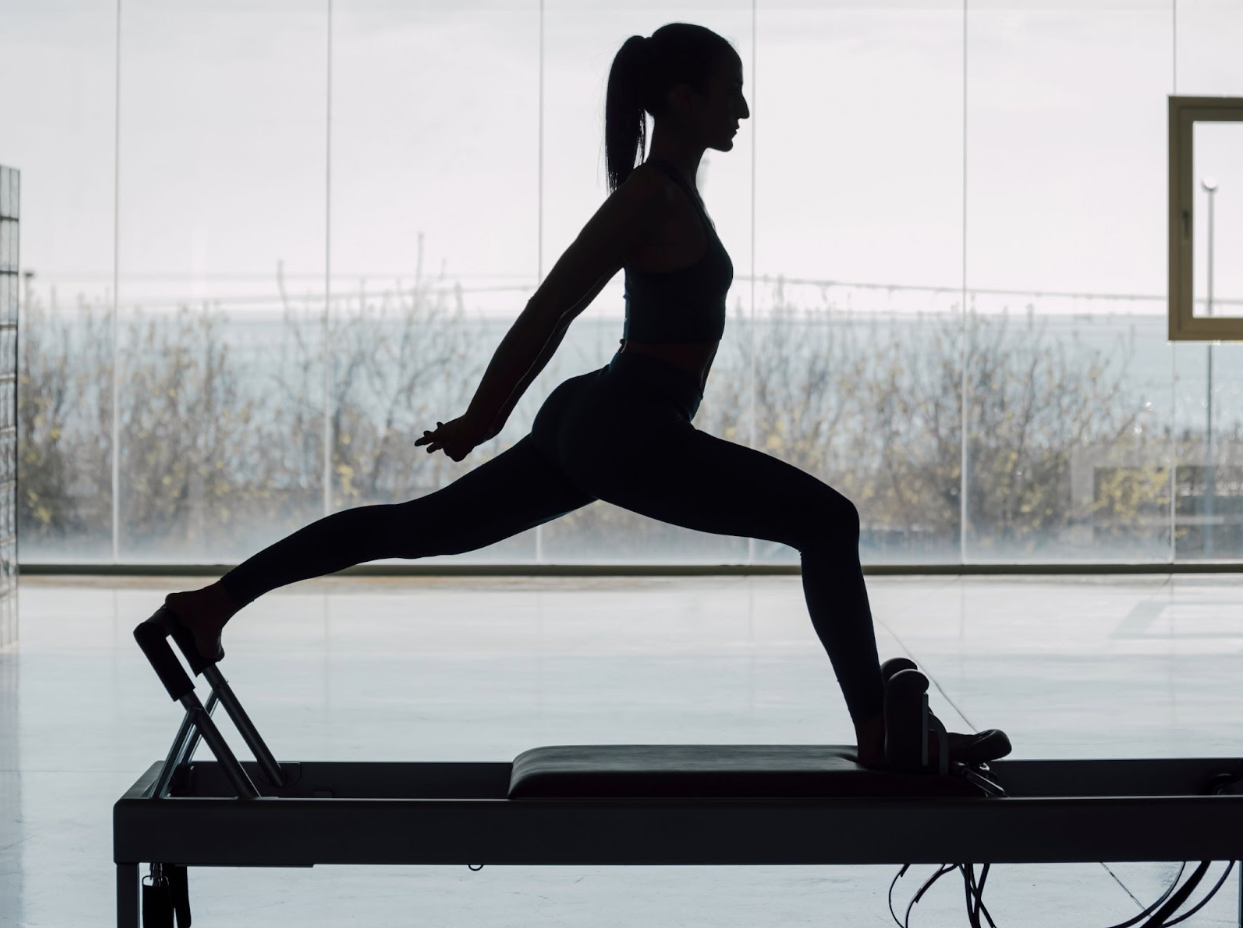
Photo via Vogue/Getty Images
***
Pilates has quickly surged in popularity, dominating both the fitness industry and social media. Consistently ranking as the most booked workout on ClassPass and with participation growing nearly 40% since 2019, it has evolved from a workout into a recognizable lifestyle and cultural trend. As its visibility has grown, so has the conversation surrounding it, and some are beginning to ask whether Pilates reflects broader social or even political values.
A recent piece by The New York Times covered a story on MaryBeth Monaco-Vavrik, a pure barre and fitness instructor, who went viral on TikTok after posting a reel captioned: “Does anyone want me to explain the connection between the popularization of Pilates & running instead of strength training…and the rise of extreme American authoritarianism?” While such a claim may overstate the relationship, it points to a larger question: how do fitness trends come to reflect the cultural moment in which they exist?
Pilates was established far from the matcha and boutique studios we associate with it today. It was founded in prison camps during World War I by German gymnast Joseph H. Pilates, who developed exercises to help rehabilitate inmates from their beds, using bed springs fixed to the walls to create resistance. In 1926, Pilates moved to New York and opened his first studio focused on his method, later patenting the spring-loaded furniture necessary for his practice. What was initially called “contrology” soon became simply known as “Pilates,” with popularity spreading particularly among dancers such as Martha Graham, Rudolf Laban, and George Balanchine, who recognized its benefits for’ strength, lengthening, and focus. The core principles of Pilates emphasize precision and control, aligning mind and body rather than prioritizing speed. Like many fitness practices, its meaning evolves and changes as it enters mainstream culture.
That shift becomes clear when placed within the broader history of fitness trends, which are consistently shaped not only by health science but by changing social values and technologies. While there is a general consensus among medical experts that physical fitness is good for you, the forms it takes have always been influenced and reflected by cultural priorities and zeitgeist. For much of the 20th century, women were discouraged from engaging in intense physical activity as sweating was seen as “unfeminine.” However, with the rise of the women’s movement and the passing of Title IX, which expanded gender equality in sports, women increasingly began to embrace their physical capabilities. During the 1970s, Jazzercise was the HITT workout, fueled by America’s dance culture and films such as Saturday Night Fever filling theaters. Around the same time, jogging surged in popularity, with women officially allowed to compete in the Boston Marathon starting in 1972.
This growing emphasis on fitness also influenced the fashion industry and cultural perception. The sporty-chic aesthetic entered mainstream style, and the first sports bra, the “jogbra,” was being sold. Similarly, bodybuilding, once stigmatized and even restricted in professional sports, was redefined by the movie “Pumping Iron,” which introduced Arnold Schwarzenegger to the world and brought men and women alike into the lift room. Even the corporate world began responding to the demands by incorporating gyms into the workplace. Across each era, fitness trends have not simply reflected health practices, but have functioned as a visible expression of shifting cultural ideals about gender, status, and bodily aesthetics.
Against this backdrop, Pilates has entered the broader fitness ecosystem, and its modern popularity is not accidental but platform and audience-compatible. Younger generations, such as millennials and Gen Z, are more fitness-oriented and health-conscious than previous generations, spending disproportionately on wellness. This is reinforced by today’s media environment, where social platforms such as TikTok and Instagram not only amplify fitness trends but also actively reshape them. Pilates has transitioned from a method focused on rehabilitation, body control, and accessibility to an aesthetic identity, packaged online as part of the “clean girl” aesthetic or the “Pilates princess” lifestyle.
This shift aligns with the broader micro-trends shaping contemporary culture. Increasingly, ideals of restraint, discipline, and “timelessness” are gaining traction across both fashion and lifestyle spaces. In fashion, the loud statement pieces and hypertrend cycles of recent years are being replaced by more neutral palettes, capsule wardrobes, and structured staples, styles often associated with a more conservative look. This pivot mirrors a wider embrace of “soft or classic femininity,” also reflected online, as seen in the rise of highly curated domestic lifestyle influencers such as Nara Smith or Hannah Neelman (aka Ballerina Farm), who embody and present traditional soft feminine roles through a modern digital lens. These cultural shifts are also reinforced at the policy level. Recent initiatives from the White House have emphasized reducing the costs of weight-loss drugs, such as Ozempic and Wegovy, to make them more affordable and accessible to consumers and normalizing the pursuit of thinness in everyday life.
As highlighted in reporting by Vogue Business, the shift in beauty standards reflects a deeper ideological change. Dan Hastings-Narayanin, deputy foresight editor at strategic foresight agency The Future Laboratory, describes the optimization trend of being skinnier, looking younger, and living longer as one that intersects and overlaps with conservatism in that “it promotes the cultural celebration of self-restraint.” Pilates, in this sense, does not create these ideals but fits into the cultural moment where thinness, soft femininity, and control are again culturally prioritized.
Ultimately, the New York Times article succeeds in identifying real patterns within Pilates culture. It is more than a fitness trend, as reflected in its exclusivity, the prevalence of repetitive body types online, the lack of diversity, and the high cost barriers. However, while these aesthetic ideals may overlap with more conservative-coded values, this does not mean that participation in pilates reflects political alignment. Rather, these patterns point to a greater cultural shift. Fitness and body ideals, fashion, and music are all shaped by the Zeitgeist and continuously evolve alongside changing social values. There has been a noticeable shift in culture towards an emphasis on discipline and optimization, in part shaped by a shifting political environment, and significantly reinforced by social media, which then amplifies and accelerates the spread of these ideals.
In this sense, Pilates is not inherently political, but it exists within a broader cultural change and reflects how trends do not emerge from a single cause but from a convergence of media influence, societal priorities, and evolving cultural norms.
***
This article was edited by Colin Mitchell and Whitney Woodrow.
 Glenmarie Rios Rodriguez
  Sarah Olivia Sullivan
  Luke Helmholz