
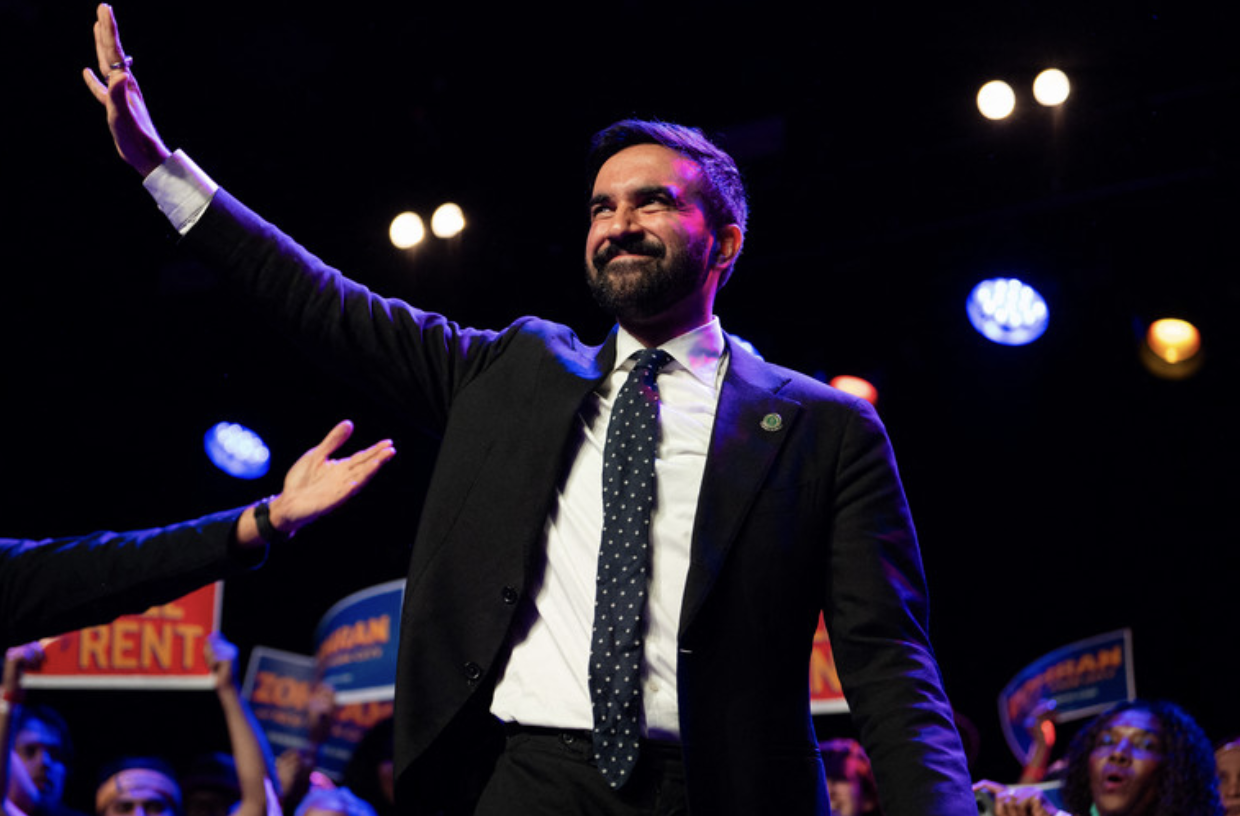
Photo via Politico
***
State Assemblymember Zohran Mamdani rose to victory all the way into City Hall. Many assume this campaign to be a local phenomenon and an isolated progressive movement that took over the most famous city in the country. But to consider Mamdani’s rise as an individual event is to miss its broader meaning. In reality, the political dynamics that shape New York City today may offer one of the clearest pathways of where the Democratic Party is headed on a national scale, and more importantly, what it means for the November 2026 Midterm elections.
It could be believed that the democratic socialists’ win was a situation that would only happen in a progressive city like New York, and at first glance, there is reasoning to that. The city has a deeply engaged group of voters that is politically active and aware, and more importantly, very left-leaning. Yet it is precisely this environment that allows emerging political trends to surface earlier and more clearly. What happens in New York does not stay in New York; it is only the beginning of a trend that is diffusing outward and shaping national conversations and campaign strategies.
People seem to gravitate towards candidates like Mamdani, and it is an indication of where the Democratic Party is going in order to survive. The party will do so by choosing candidates who combine an unapologetic progressive agenda with highly effective and modern communication strategies. Unlike politicians who choose more traditional methods of campaigning and choosing institutional backing, Mamdani has built his profile through direct engagement with voters, especially younger and more digitally connected voters. The now Mayor’s messaging is clear, driven by his values and extremely accessible, which are qualities that are needed in an age where attention spans are getting shorter, and authenticity is almost non-existent.
This magical combination raised the mayor to power and is now critical if Democrats want to take over Capitol Hill. Political analysts have said for years that Democratic politics is a tension between moderates and progressives, often suggesting that more left-leaning candidates risk alienating broader electorates. Still, this unprecedented rise complicates this exact narrative. It suggests that the question is not only what candidates stand for, but how they choose to communicate those beliefs. When candidates pair progressive policies with digestible, accessible, and compelling messaging, it is much more electorally viable than conventional wisdom assumes.
New York also has another interesting dynamic to consider: the centrality of narrative in modern campaigns. The issues that took the forefront in the last mayoral election, like housing, public safety, and economic inequality, are not new issues, but the way that they are framed has changed a lot over the years. When candidates choose to portray these issues not just as abstract policy debates but as lived experiences that voters relate to personally, they end up with massive success. Mamdani’s ability to frame these crucial and complex structural issues into very human-centered and emotional narratives shows a much broader transformation in political communication, which is one that is likely to shape midterm campaigns across the country.
More importantly, this shift comes at a time when Republicans have chosen to lean into a very nationalistic and messaging in campaigns that fear-monger, talk about crime, and are very culturally divisive. Democrats face the challenge to respond to these messages in a clear and empathetic way without losing sight of proposing meaningful policies. The model that was seen in the last New York City mayoral election shows a bright path forward where candidates embrace bold positions while transmitting direct, urgent, and grounded messages that talk about everyday life.
Candidates have not lost sight of the implications for the midterm and how significant the next couple of months will be. If Democratic candidates are able to replicate this model of combining strong ideological clarity along with effective, platform-savvy communication, they will be better positioned to mobilize key voter groups, especially younger and urban populations. These groups are often those who end up making the difference in elections, but also influence the turnout. Those candidates who are able to properly meet these voters where they are, both politically and digitally, will end up triumphant.
This argument is not a suggestion that national elections will or even should mirror the New York City formula exactly. The national electorate is much more diverse ideologically, and the physical, ideological, economic, and social differences remain significant. However, New York has shown that authenticity, effective digital communication, and progressive messaging might be the way to effectively take the House and the Senate in a landslide. This strategy should not be confined to one city, and even those career politicians who have been doing this for decades should take this strategy very seriously, as the people have shown that it works.
More critically, even when at odds with each other, when it comes to elections or even once in office, Republicans always find a way to stick together to push forward their agenda. Democrats have historically chosen to point at each other rather than learn from the other party and choose a way to be a strong opposition. If Democrats want to take the elections successfully, they need to learn a way to put their ideological differences and alliances aside, and start working together to get the difficult electorates that are going to be the deciding groups in November.
If candidates can learn anything from the current mayor of New York City, it is that people are trying to survive in difficult economic and social circumstances, so the last thing that they want is for their leaders to be distracted and not be effective policy makers. Mamdani was able to identify those key factors that people care about, and promised that even if it’s hard, he will try his hardest to go against the status quo. At the beginning of his campaign, the polls showed that he was not a contender for the win. Yet, his success showed that the ones who decide who ends up succeeding are the people. If the Democratic Party successfully chooses this strategy, replicates it, and supports each other, people will choose them as their next leaders, and it will result in control of the House and the Senate.
If anything, Mamdani’s rise shows a Democratic Party that is becoming more confident in its identity, and shows a formula of effective communication. The combination of clarity of vision and clarity of message has been a historically successful formula within American politics.
As the midterms rapidly approach, the question is no longer whether these strategies can lead to actual wins beyond New York. It is whether Democratic leaders and candidates across the United States will adopt them quickly enough to catch people’s attention. If they do, the political atmosphere that is currently visible in New York City may not remain local for long; it may instead translate into a national advantage at the ballot box.
***
This article was edited by Abigail D’Angelo.
 Glenmarie Rios Rodriguez
  Sarah Olivia Sullivan
  Luke Helmholz