
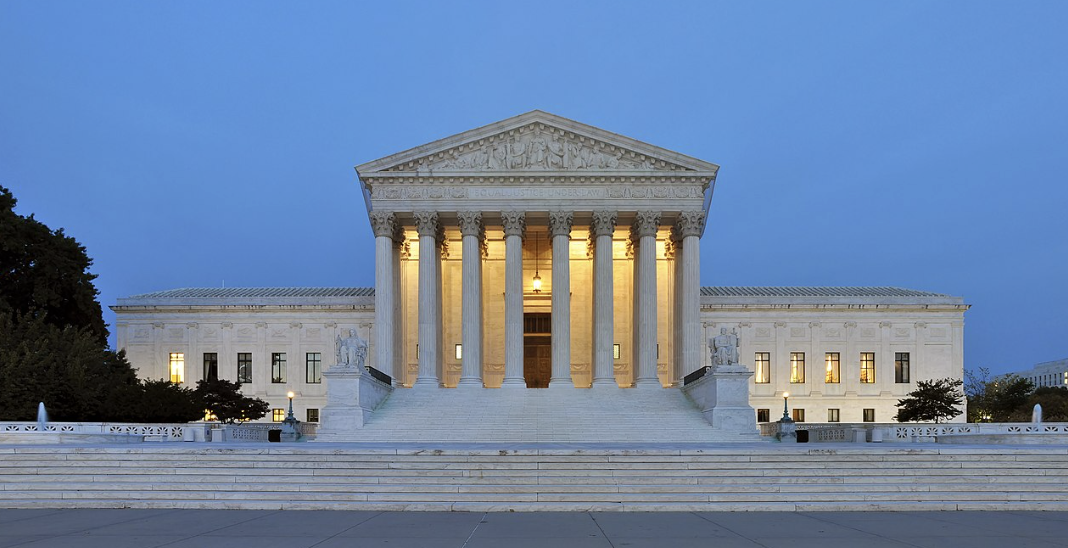
Photo via Wikipedia
***
On January 20th, 2025, the first day of his second term, President Donald Trump signed an executive order titled “Protecting the Meaning and Value of American Citizenship.” The order aims to end birthright citizenship for children born in the United States to undocumented immigrants or parents with temporary status. It is introduced with the Fourteenth Amendment: “All persons born or naturalized in the United States, and subject to the jurisdiction thereof, are citizens of the United States and of the State wherein they reside.” However, the Trump administration believes that the Fourteenth Amendment has been misinterpreted and was not intended to extend citizenship universally to everyone within the United States. The administration believed that United States citizenship does not extend to persons born in the United States when the person’s mother is illegally present in the United States and the father was not a United States citizen or lawful permanent resident at the time of the birth.
The concept of birthright citizenship is not new. It stems from the principle of jus soli, granting automatic citizenship to children born within a country’s territory, regardless of the parents’ nationality. Many legal experts regard birthright citizenship as the bedrock of the United States and enshrined into the Constitution by the Fourteenth Amendment, unlike Trump’s administration.
United States v. Wong Kim Ark
The first test of the Fourteenth Amendment came in the mid to late 1890s at the height of anti-Chinese immigrant sentiment. The Chinese Exclusion Act of 1882 was a federal law signed by President Chester A. Arthur suspended immigration of Chinese laborers for 10 years and prohibited them from becoming naturalized. Wong Kim Ark, a Chinese American citizen, was born in San Francisco to Chinese citizens who lived in the United States at the time. He visited his parents in China, who previously lived in the United States for 20 years. After traveling back to the United States, Wong was not permitted entry into the country due to not being a citizen.
Wong’s case was brought up to the Supreme Court on the legal question: Is a child who is born in the United States to non-citizen parents who are lawful permanent residents of the United States citizens under the Citizenship Clause of the Fourteenth Amendment? The Court concluded that since Wong was born in the United States and his parents were not “employed in any diplomatic or official capacity under the Emperor of China,” the Citizenship Clause of the Fourteenth Amendment makes him a United States citizen. The Court established the concept of jus soli in this case.
United States v. Wong Kim Ark (1898) has been a legal precedent for over a century—until now. The Trump administration’s new interpretation of the Fourteenth Amendment has forced the question of should the precedent be changed, and how can it?
Barbara v. Trump
In June 2025, the American Civil Liberties Union and its partners, Legal Defense Fund, Asian Law Caucus, and the Democracy Defenders Fund, sued President Trump for his executive order targeting birthright citizens. Federal courts have blocked the executive order, finding it violates the Constitution and a century old Supreme Court precedent. The class action lawsuit, Barbara v. Trump, was first heard in the Supreme Court on April 1.
The facts of the case are as follows. On January 20th, 2025, President Trump issued Executive Order No. 14,160, declaring that children born in the United States are not citizens if their parents are not of sufficient legal status. Three families challenged the order: Barbara, a Honduran asylum applicant whose child was born in October 2025, Susan, a Taiwanese citizen on student visa whose child was born in April 2025, and Mark, a Brazilian applicant for permanent residence whose child was born in March 2025. They families filed the suit alleging that the executive order unlawfully strips their children of U.S. citizenship, and seek to preserve access to benefits like Social Security, SNAP, and Medicaid.
Oral arguments of the case started with D. John Sauer representing President Trump and Cecillia D. Wang representing the ACLU. Already, the Supreme Court has seemed to express concerns about the administration attempting to replace precedent with their own interpretation of the law. President Trump’s defense pulled legal theory from the Wong Kim Ark case to argue their position, stating that to be “subject to jurisdiction” means to be within “political” jurisdiction of the nation, meaning that children of undocumented immigrants or lawfully present immigrants with green cards are not entitled to birthright citizenship because their parents presence is either illegal or temporary. They interrupt the Fourteenth Amendment very narrowly, arguing that the drafters of the Constitution only wanted to offer birthright citizenship to citizens of enslaved people who had been denied citizenship under Dred Scott (1857). Sauer argued that the drafters wanted to steer the United States away from common law rules of birthright citizenship and aimed to grant citizenship to those whose parents were legally “domiciled” in the United States. By definition, domiciled refers to someone’s intent to live somewhere permanently. Those without citizenship and temporary residences cannot legally become “domiciled” because their long term percentage is illegal, and thus, their children should not be granted birthright citizenship.
Many of the justices did not agree with the Trump Administration’s legal reasoning, even the more conservative ones. Chief Justice Roberts stated that their arguments were “quirky” and the exceptions they were suggesting did not seem to follow the precedent set in Wong Kim Ark. Justice Gorsuch, who suggested that it was “striking” that the basis of their argument focused on allegiance and domicile, even though they were rarely discussed in the debates around the Fourteenth Amendment. Justice Barret inquired whether babies dropped off at hospitals without knowledge of their parents would be considered citizens, and Justice Jackson asked how it would be determined at birth whether a child would be considered a citizen. The only Justice that seemed to openly support Sauer’s argument was Justice Alito, telling Cecillia Wang that the Wong Kim Ark decision mentioned domicile 20 times.
Implications of the Case
If the Supreme Court were to rule in favor of the Trump Administration, there would be heavy implications for the country. Firstly, all children born in the United States to undocumented or temporary visa holders would no longer be considered citizens, and the government would need to develop administrative systems to determine parental immigrant status. The government has stated the order would not apply to those who already hold citizenship. Additionally, local governments highlight that stateless individuals would be excluded for core aspects of American life: voting, welfare programs, and serving on juries. Stripping birthright citizenship will increase poverty rates by stripping access to federal funded programs and services and disproportionately impact communities of color, countering the intent of the Fourteenth Amendment.
Another implication would be the overturning of a 128 year precedent that has been the bed rock of birthright citizenship. The Fourteenth Amendment has equally protected citizenship by birth within United States territories for all children born from residents or undocumented immigrants. The government is suggesting a rereading of one of the Civil War Amendments, which suggests implications beyond just citizenship. If the government can narrow the Citizenship Clause, could they narrow the scope of other amendments that could take fundamental liberties away? Ultimately, the case is about the separation of powers and whether or not the president can reinterrupt a constitutional amendment and disregard a landmark case. If the Supreme Court blocks the case, it reinforces a fundamental pillar of the United States government, separation of powers, regardless of who is seated in the White House.
Trump v. Barbara stands as one of the most consequential constitutional cases in over a century. It is not merely about birthright citizenship, but also a test of if the Executive Branch can reinterpret a constitutional amendment that has been governing American life for 150 years. Based on skepticism from the Supreme Court, it seems like the majority of justices would like to reaffirm the principle estached in Wong Kim Ark, that every child born on American soil is a citizen. Ruling against the executive order would be a clear message that the Constitution is not subject to executive reinterpretation and the separation of powers must be upheld.
***
This article was edited by Abigail D’Angelo.
 Glenmarie Rios Rodriguez
  Sarah Olivia Sullivan
  Luke Helmholz