
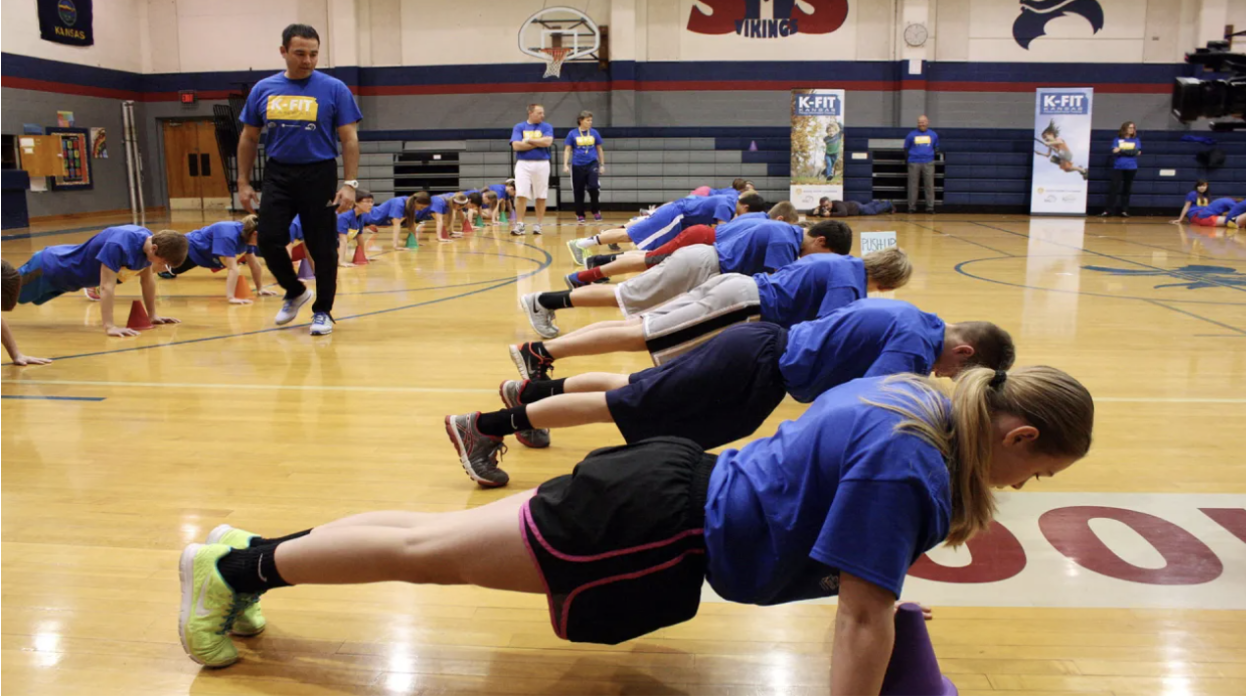
Image via Rochester First
***
Seventy-one percent of Americans aged 17-24 are ineligible for military service. The leading factor is not criminal history, educational deficiency, or cognitive limitation. It is obesity. This statistic, reported by the Department of Defense, represents more than a recruitment crisis. It represents a collapse in the physical capacity of an entire generation—one shaped by policy choices that prioritized convenience over capability, profit over nutrition, and pharmaceutical interventions over prevention.
The United States must implement National Health and Fitness Standards (NHFS) from sixth grade through college—not to optimize citizens for economic productivity or military utility, but to secure the physical foundation necessary for autonomous, dignified adult life. A body that cannot climb stairs, sustain focus, or resist metabolic disease is a body denied full participation in civic, professional, and personal life. Physical literacy represents a baseline civic competency, as essential as numeracy or language.The federal government possesses the constitutional authority to establish these standards under the spending clause, which permits Congress to condition federal education funding on state adoption of health benchmarks serving the general welfare. This is not a mandate but an incentive structure. States retain full autonomy to decline participation; those that accept do so voluntarily in exchange for enhanced federal support, mirroring precedent established in South Dakota v. Cole (1987) and programs like Race to the Top—a competitive federal grant program that encouraged education reform.
The Structural Origins of Decline
Since 1960, adult obesity rates have tripled. The Centers for Disease Control and Prevention reports that obesity now affects one in five children and adolescents. For the first time in modern history, adolescents are diagnosed with Type 2 diabetes and hypertension. This reflects institutional design: digital technology eliminated incidental movement from daily life, and ultra-processed food colonized the diet. The response has been pharmaceutical. GLP-1 agonists like Ozempic and Wegovy are merely moving goal posts, addressing symptoms, not root causes, transferring cost to insurers without building cardiovascular capacity.
The Science of Fitness and Longevity
Cardiovascular fitness, measured as VO2 max (maximal oxygen uptake), is among the strongest predictors of all-cause mortality. A 2018 study in JAMA Network Open, analyzing over 122,00 patients, found that low cardiorespiratory fitness carried mortality risk comparable to major cardiovascular disease. Research from the Cleveland Clinic demonstrated that individuals in the lowest fitness quintile faced mortality rates approximately five times higher than those in the highest quintile, with improvements from low to moderate fitness yielding risk reductions comparable to smoking cessation.
However, fitness correlates with income, education, and healthcare access. Reverse causality and selection bias complicate interpretation. Nevertheless, the causal case is strong. Randomized controlled trials demonstrate that exercise interventions improve cardiovascular markers and cognitive function. Mendelian randomization studies support causal effects of physical activity on mortality risk and cardiovascular disease prevention. The Bradford Hill criteria are satisfied. While not deterministic, fitness represents a modifiable factor with substantial population-level impact.
Additionally, muscular strength reinforces the case. Longitudinal studies demonstrate that individuals maintaining strength experience lower rates of cardiovascular disease, diabetes, and cognitive decline. The fitness assessments proposed—hand-release push-ups, standing power jump, plank, PACER—are validated proxies for capacities that determine both lifespan and quality of life.
The Proposal
Framework
NHFS would establish federally guided, state-administered benchmarks for students from sixth grade through college. Body composition screening using height-to-weight ratios would be supplemented by Waist-to-Height Ratio assessments to differentiate excess adiposity from lean mass. Bi-annual fitness testing would assess cardiovascular endurance and functional strength. Nutritional literacy and mental resilience education would be integrated as graded requirements.
Enforcement and Incentive Structure
NHFS operates through conditional federal funding and individual incentives, not mandates. States accepting federal education grants would be required to implement fitness testing and report aggregate outcomes, mirroring Title I compliance mechanisms. Schools meeting participation thresholds (90 percent of eligible students tested) would qualify for enhanced physical education funding. Students exceeding standards throughout their academic careers would qualify for federal tax credits in early adulthood, structured deduction comparable to education savings account benefits. Critically, tax credit eligibility would be need-adjusted: students from households below 200 percent of the federal poverty line would receive enhanced credit amounts, ensuring the policy does not function as a regressive wealth transfer to the already advantaged. This creates institutional motivation (schools gain funding) and individual motivation (students gain tax advantages) without punitive enforcement.
Importantly, students with documented disabilities, chronic conditions, or genetic disorders would be categorically exempt, with medical certification determining eligibility. Additionally, the framework recognizes genetic non-responders—individuals who exercise consistently but demonstrate limited improvement in specific metrics due to genetic variation in trainability. Exemption processes would include transparent appeals, longitudinal performance tracking to distinguish effort from outcome, and protection against discrimination. The framework targets preventable conditions within individual control, not biological lottery outcomes.
The Civic Foundation
The moral case rests on a civic republican understanding of citizenship and a social contract conception of shared obligations. In political theory, civic republicanism holds that citizens bear duties to maintain the capacities necessary for self-governance and collective flourishing—not as instruments of state utility, but as preconditions for autonomous participation in democratic life. Just as universal literacy enables informed voting and jury service, physical competency enables labor force participation, military service when called, and caregiving responsibilities. The state’s legitimate interest is not in coercing fitness but in ensuring every citizen has access to the education and resources necessary to achieve it. This represents intergenerational stewardship: current generations investing in the physical capital of future generations who will bear shared fiscal burdens through Medicare, defense obligations, and economic productivity. NHFS is an exercise of legitimate state interest in population capability, grounded in public health precedents from vaccination to water fluoridation.
To be clear: meeting fitness standards would not be a legal requirement for citizenship, voting, or any civil right. The framework incentivizes capability development, not legal disenfranchisement.
Complementary Food System Reform
Individual fitness standards are necessary but insufficient. NHFS should be paired with reforms restricting marketing of ultra-processed foods to children, revising agricultural subsidies, and strengthening nutritional standards in federal meal programs. However, NHFS can succeed independently; fitness outcomes improve even absent food system transformation.
Equity requires universal access. NHFS would allocate federal funding to underserved communities for safe recreational facilities, school fitness programs, and nutritious meal improvements, with resources scaling to need. This front-loaded infrastructure investment addresses the concern that students in resource-poor environments cannot fairly compete for tax credits.
The Economics of Prevention
The Congressional Budget Office projects Medicare and Medicaid spending will reach 10 percent of GDP by 2050, driven substantially by obesity-related conditions. A 2018 RAND Corporation study estimated that poor population health costs the U.S. economy approximately $530 billion annually in lost productivity—a figure that dwarfs the $12-15 billion investment NHFS would require. Even under conservative assumptions—60 percent program compliance and 15 percent obesity reduction over 20 years—federal healthcare savings would likely reach $60–$70 billion annually by 2045, yielding a return on investment exceeding 4:1. The alternative—continued pharmaceutical dependency and workforce attrition—is economically unsustainable.
Implementation: The Surveillance Question
NHFS faces implementation barriers, of which privacy concerns are most politically volatile. Collecting biometric data on millions of students invites the ‘Big Brother’ critique: a federal fitness database evokes dystopian imagery regardless of intent. Past federal data initiatives—from standardized testing databases to health information exchanges—have experienced breaches, unauthorized access, and mission creep beyond original purposes. The optics matter as much as the mechanics.
Three design principles mitigate surveillance concerns. First, data minimalism: NHFS would collect only aggregate pass/fail outcomes at the school level, not individual biometric profiles. Individual fitness data remains locally controlled by schools and parents, never transmitted to federal databases. Second, sunset provisions: student records are automatically deleted upon graduation, preventing lifelong tracking. Third, constitutional firewalls: federal legislation would explicitly prohibit use of fitness data for insurance underwriting, employment decisions, law enforcement, or military recruitment—with criminal penalties for violations. The model is not a national registry but a federated system where compliance is verified through statistical sampling, not centralized surveillance. This mirrors how Title I funding compliance is audited: schools report aggregate outcomes, not individual student records. The model is not a social credit system; it is a public health infrastructure investment with strict privacy protections.
Implementation would proceed through three phases over ten years: competitive grants to participating states, expansion to federally funded schools with privacy frameworks operational, and activation of tax incentive structures. Estimated federal investment: $12–$15 billion annually during peak implementation, declining to $6–$8 billion sustained (approximately 0.2 percent of federal spending). Political feasibility depends on bipartisan framing: conservatives may support workforce readiness and military recruitment; progressives may support health equity and public investment.
Conclusion
The moral foundation for NHFS is human capability and civic obligation. Physical fitness is intrinsically valuable because it expands what individuals can do, experience, and become. A sedentary body is a constrained body—limited in career options, recreational participation, caregiving capacity, and lifespan. NHFS treats physical competency as a precondition for full citizenship, comparable to literacy or civic knowledge.
This proposal will face resistance. But the alternative—continued institutional failure, pharmaceutical dependency, and diminished physical capacity across generations—is morally, economically, and strategically unacceptable. The cost of inaction is $530 billion annually in lost productivity, a defense recruitment crisis that threatens national security, and a population less capable with each passing generation. Against this, NHFS requires $12–$15 billion annually—less than 3 percent of current annual losses. The return is measured not just in healthcare savings, but in the restoration of a population capable of meeting the demands of citizenship, service, and self-determination. America built universal public education because literacy was essential to democracy. Physical literacy deserves the same commitment.
***
This article was edited by Samantha Morales.
 Sarah Olivia Sullivan
  Luke Helmholz
  Gavin O'Sullivan