
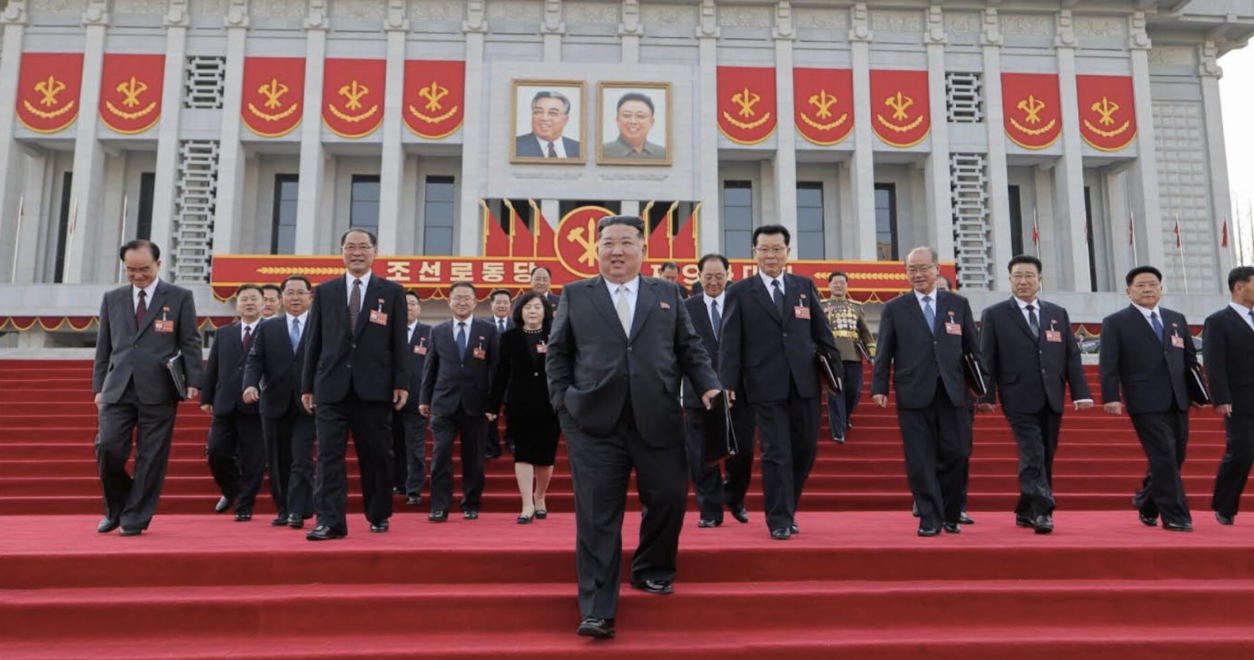
Photo via NK News
***
In an era defined by instant access to information, North Korea stands apart as one of the world’s most tightly sealed states, where knowledge flows inward and outward only in carefully controlled fragments. To many, North Korea remains a fascinating mystery, considering it has managed to remain so isolated that its people know almost nothing of the outside world, and we on the other side know very little. Few political events offer meaningful insight into this tightly controlled system, but the Party Congress stands out as one of the rare moments when the regime signals its priorities to domestic and international audiences.
From February 19 to February 25 of 2026, North Korea convened its Ninth Party Congress. This multi-day event, held only once every five years, brings together elite officials to set national policies, amend party rules, and elect leadership. The most recent congress followed the same format as the Eighth Party Congress in 2021: an opening speech and work review on day one; additional reviews on days two and three; amendments to party rules and leadership elections on day four; a Central Committee meeting and sectoral policymaking on day five; finalization of sectoral policies on day six; and a Politburo meeting, closing speeches, and a military parade on the seventh and final day. Although the North Korean media was deliberate in revealing how the events surrounding the congress unfolded, this congress remains extremely significant, given that it is one of the few instances in which the rest of the world is able to gain insight into the politics and goals of one of the most isolated dictatorships in the world.
Along with the Ninth Party Congress, providing the rest of the world with political information regarding North Korea, it also allows us to comprehend their view of the rest of the world, with whom they align themselves, and who they see as a threat. During this most recent Party Congress, several important trends in North Korea’s political and strategic posture were underscored. Most notably, the gathering highlighted Kim Jong Un’s growing confidence in both his domestic authority and the country’s nuclear capabilities. Since taking power in 2011, Kim has overseen a dramatic expansion of North Korea’s nuclear arsenal, from a small number of warheads to an estimated stockpile of at least fifty, alongside intercontinental ballistic missiles capable of reaching the United States. At the congress, Kim declared the country’s status as a nuclear weapons state “irreversible and permanent,” signaling continued refusal to denuclearization talks with the United States. The meeting also revealed a sharp rhetorical shift toward South Korea, which Kim now characterizes as North Korea’s “principal enemy,” a significant departure from earlier reunification language. Finally, the regime projected confidence in its domestic economic agenda, emphasizing industrial development plans while notably downplaying the impact of international sanctions. Together, these signals suggest a leadership that is increasingly secure at home and more assertive abroad.
Though some of the information available may be filtered, what North Korea has communicated abundantly clear is its reinforced stance that it intends to double down on military strength and strategic autonomy. According to assessments from the Korea Economic Institute (KEI), the new five-year plan prioritizes qualitative development in key economic sectors while maintaining a strong emphasis on its defense capabilities and self-reliance. At the same time, North Korea’s rhetoric surrounding the congress reflected heightened sensitivity to global security developments. In particular, Kim’s sharp condemnation of recent U.S. military action in Venezuela illustrates how the regime interprets foreign interventions as justification for its own nuclear deterrent. The recent takedown of the Maduro regime in Venezuela likely strengthened Kim Jong Un’s conviction that nuclear weapons are essential for regime survival, especially as the United States demonstrated its willingness to use force against adversarial governments. North Korea even emphasized that, unlike Venezuela, it possesses a credible nuclear deterrent, underscoring the regime’s growing assertiveness about its weapons programs. This context thus helps explain why the congress repeatedly reinforced the permanence of the country’s nuclear status and continued investment in advanced weapons systems.
Overall, the Ninth Party Congress portrays a leadership that feels more secure yet more defensive about its long-term survival. With economic plans focused on controlled domestic development and security policy shaped by both regional tensions and global precedents like the U.S. action in Venezuela, and recent wars, Kim Jong Un’s regime appears firmly committed to strengthening deterrence and strategic independence. Unless external conditions shift dramatically, North Korea is likely to continue along this more assertive, security-first trajectory through the continued development of nuclear weapons.
***
This article was edited by Abigail D’Angelo
 Abby Coxe
  Campbell Brown
  Holmes Wormald