
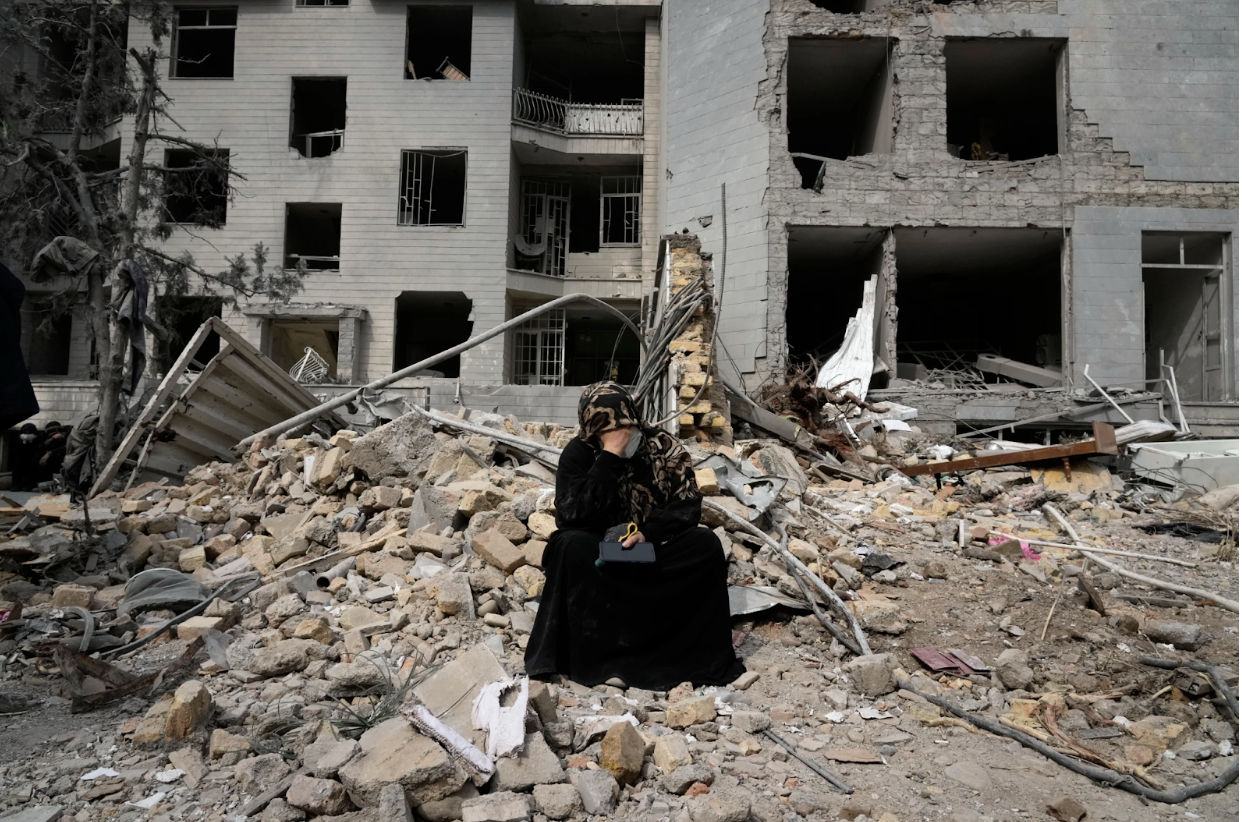
Photo via Associated Press
***
On February 28, 2026, the United States and Israel launched an illegal war on Iran. Since then, over 4,000 people have been killed, including over 300 children, 13 United States service members, and dozens of aid workers. The war has permeated throughout the Middle East, with over 12 countries reporting casualties or military involvement. 3.2 million Iranians and at least a million Lebanese have been displaced, and critical civilian infrastructure has been destroyed across the region. The damages have also disrupted the global economy, particularly due to the closure of the Strait of Hormuz, a critical shipping route for about a fifth of the world’s oil.
The illegality of this war is rooted in both domestic and international law. Under Article I, Section 8 of the U.S. Constitution, only Congress has the power to declare war, even though the President serves as the Commander in Chief of the armed forces. President Trump did not receive congressional authorization before initiating military action, despite the fact that both he and Secretary of War Pete Hegseth have repeatedly described the conflict as a war. Furthermore, the 1973 War Powers Resolution (WPR) outlines additional checks on executive war power. The WPR states that a President may only exercise military action if the action is authorized by either a declaration of war, specific congressional statutory authorization, or “a national emergency created by attack upon the United States, its territories or possessions, or its armed forces.” Trump has attempted to work his way around the law by claiming that Iran posed an imminent threat to the national interests and security of the United States, yet neither Trump nor the Pentagon has offered any evidence to support this claim. In fact, the director of the National Counterterrorism Center, Joe Kent, resigned over the Iran war, stating, “Iran posed no imminent threat to our nation, and it is clear that we started this war due to pressure from Israel and its powerful American lobby.”
The U.S. and Israel’s war on Iran is also illegal under international law. The United Nations Charter establishes that “all Members shall refrain in their international relations from the threat or use of force against the territorial integrity or political independence of any state.” The UN only provides two exceptions to this prohibition: the use of military force in a legitimate claim of self-defense, or the use of force authorized by the United Nations Security Council. With this war on Iran, the United States has met neither condition.
On April 13, over 100 international law experts, professors, and practitioners signed an open letter raising concerns about U.S. strikes violating UN regulations and international humanitarian law, potentially amounting to war crimes. These experts were also alarmed over the rhetoric used by U.S. officials. On March 2, 2026, Pete Hegseth stated that the U.S. will not fight with “stupid rules of engagement.” On March 13 he added, “We will keep pushing, keep advancing, no quarter, no mercy for our enemies.” The term “no quarter” implies that enemy combatants would not be taken prisoner but executed instead. According to Article 23(d) of the 1907 Hague Convention, it is a war crime to “declare that no quarter will be given,” which the Department of Defense’s own Law of War Manual reaffirms.
On April 7, 2026, Donald Trump posted on Truth Social, “A whole civilization will die tonight, never to be brought back again.” This threat of genocidal intent and civilian annihilation, if carried out, would result in catastrophic suffering and shatter the very foundation of international law. And for weeks before that, Trump threatened to attack civilian infrastructure such as bridges and power plants, claiming that he would “blow up the entire country” if Iran did not meet his demands. International law clearly asserts that attacking civilian infrastructure amounts to war crimes.
The Trump administration not only threatens to commit war crimes, but they admit to committing them, too. On April 2, 2026, the United States military bombed the B1 Bridge linking the city of Karaj to Tehran. This attack destroyed Iran’s largest bridge, killed eight people, and wounded 95 others, most of whom were civilians. Trump claimed responsibility for the attack, posting a video of the explosion and writing on Truth Social, “The biggest bridge in Iran comes tumbling down, never to be used again—Much more to follow.” Additional Protocol I, Article 52, of the Geneva Conventions states, “Civilian objects shall not be the object of attack or of reprisals. Civilian objects are all objects which are not military objectives as defined in paragraph 2.” A U.S. military official claimed that the bridge was targeted to eliminate a “planned military supply route for Iran’s missile and drone forces.” However, the bridge was still under construction and not yet operational, and a preemptive strike on a civilian infrastructure target to eliminate potential military activity is a weak legal claim. Furthermore, even if the bridge was being used for military purposes, the United States would be required to perform due diligence of proportionality to confirm that the attack would not be “expected to cause incidental loss of civilian life, injury to civilians, damage to civilian objects, or a combination thereof, which would be excessive in relation to the concrete and direct military advantage anticipated.” Brian Finucane, a former State Department lawyer, commented, “My read is that bridge was targeted not to provide any military advantage but in the hopes of coercing Tehran and generating content.”
American war crimes have been more severe than just eliminating bridges. America has bombed schools, hospitals, residential buildings, water desalination plants, energy compounds, medical facilities, and other civilian objects. The Iranian Red Crescent reports that over 67,414 civilian sites have been struck, of which 763 were schools and 316 were health facilities. Of these attacks, one of the bloodiest was on an elementary school.
On February 28, the first day of the war, the U.S. struck Shajareh Tayyebeh Primary School for girls in Minab, Iran. The school was hit in a precision strike by a Tomahawk cruise missile, destroying the building killing 175 people, most of whom were schoolgirls aged seven to 12. Trump immediately denied responsibility for the attack and even insisted that Iran bombed its own school. Multiple media outlets, humanitarian groups, and independent investigations have proven this claim to be false, alongside a preliminary investigation by the U.S. Department of Defense, which concluded that the U.S. was at fault for the attack. Even though the school was adjacent to an Iranian military compound, satellite imagery shows that the building had been walled off for nine years, with clear visible markings identifying the site as an educational facility. The school also had a years-long online presence, showcasing educational events and schoolgirls at work and play.
The U.S. military uses advanced multi-domain intelligence collection methods to assess the legitimacy of military targets, and because evidence shows that this strike was a precise target, it is clear that there was an obvious misalignment in targeting information, potentially indicating that this attack was either deliberate or reckless. Furthermore, there has been no evidence proving that the school was being used for Iranian military activity, making arguments for the strike null under international law. And similar to the B1 Bridge strike, even if the school was being used for military purposes, the U.S. would have to perform due diligence of proportionality to prove that the “anticipated harm to civilians and civilian objects is disproportionate compared to the expected military gain from the attack.” Therefore, this strike is a clear violation of international humanitarian law, breaching the Geneva Conventions, the 1989 Convention on the Rights of the Child, the International Criminal Court Rome Statute, and the 1999 UN Security Council Resolution on Children and Armed Conflict.
Since the start of the war, American and Israeli forces have struck at least six oil and natural gas sites in Iran. On March 7, a joint U.S-Israeli attack targeted the Aghdasieh fuel depot in Tehran. The strike obliterated the depot, causing thick clouds of black smoke to cover the Iranian atmosphere, blocking out sunlight. The prolonged plumes of smoke have caused dangerous levels of pollution, with local authorities and the World Health Organization reporting acid and toxic rain. Imagery has shown layers of black soot covering everything from plants to city cats. Additionally, these strikes have raised concerns that the environmental consequences have the potential to severely contaminate food and water sources, which would be catastrophic for the local population.
Three other oil depots were also attacked on March 7, causing similar effects to the Aghdasieh Strike, one of which was the Fardis oil depot. Local authorities claim that the strike killed six people and injured 21 others, and high-resolution satellite imagery shows damage to a primary school and medical facility near the depot. Residents of the surrounding areas reported harmful respiratory symptoms after the attack, and environmental and health experts claim that the attacks “could cause acute and chronic health effects on nearby residents, possibly for decades.”
Human Rights Watch confirmed that all four depots were used for civilian purposes and could not determine that they were used for any military activity. Additionally, the United Nations Environment Programme condemned and confirmed the attacks, stating, “Heavy smoke from burning oil, which includes hazardous compounds, is now being directly inhaled by people in Iran—including young children—raising serious concerns about long-term impacts on both human and environmental health.”
These attacks violate Article 55, Section I of the Protocol Additional to the Geneva Conventions, as well as multiple sections of Article 52. The strikes also violate Rule 45 of customary international humanitarian law. And because of Israeli-U.S. admissions of knowledge and intent of the bombings, these attacks are unquestionably war crimes.
While the U.S. does have a history of illegal war actions, the level of consistency, destruction, and lethality of American strikes in the Iran war is almost unprecedented. This war, which already began on illegal grounds, represents a level of rotted morality and a complete legal disregard by the Trump Administration and the Department of Defense. It is shameful how little mainstream media has covered these illegal attacks. The New York Times has covered only a minuscule number of reported American attacks on civilian infrastructure. Other news outlets across the political spectrum have also failed to adequately cover American breaches of the Laws of War. The lack of journalistic coverage only incentivizes military officials to continue violating international law in pursuit of war aims, and builds a foundation of unaccountability that prevents war criminals from facing justice. Subsequently, Pete Hegseth has fired the military’s top lawyers for war crime prosecutions and battlefield rules of engagement. He has also terminated “Pentagon offices and positions that focus on preventing and responding to civilian harm during U.S. combat operations.”
Innocent people suffer the consequences of this impunity.
On February 28, an explosion ripped through Imam Reza Elementary School for boys in Abyek, Iran. It killed one child, damaged school infrastructure, and sent 40 young boys running from the playground to seek shelter. On the same day, the U.S. bombed a sports hall, an adjacent elementary school, a blood transfusion center, and residential buildings in Lamerd, Iran. Local authorities reported that the attack killed 21 and injured over 100 others, many of whom were confirmed to be children. Dozens of teenage girls were training in the sports hall at the time, and many of them were killed in the strike.
On March 31, Israeli-U.S. strikes targeted one of Iran’s largest cancer drug facilities, damaging infrastructure and supply lines. Within the same month, Delaram Sina Psychiatric Hospital, Ali Hospital, and Gandhi Hospital were all damaged by attacks, some with patients inside during the bombings. After being forced to evacuate all patients because of the strikes, the president of Gandhi Hospital told the media, “We have newborn babies… we had eight patients in the I.C.U., two in critical condition. Women giving birth. Embryos in our fertility department.”
The bombings also forced the Bushehr Medical Complex to evacuate babies. Video shows a medical worker in the damaged newborn ward looking over an infant, saying, “If we disconnect what they’re hooked up to, they will die. Look at them. This poor kid. This dear child.” The video then cuts to emergency workers moving babies from their specialized care units into ambulances on the street. The World Health Organization has verified at least 23 strikes on the Iranian health care system and facilities, resulting in dozens of deaths and injuries, immobilizing healthcare delivery, and forcing patients to face life-threatening delays in treatment.
Once again, news agencies have barely reported on these crimes.
In the midst of this widespread assault on international and domestic law by the United States, it is important to remember that part of loving our country means holding it accountable. Disregarding the wicked immorality and illegality of our government will only continue cycles of human suffering. The United States has broken international humanitarian law. It has committed war crimes. It has killed children. And at a time when these crimes are so unspoken, so hidden from us, it is essential to take the extra step to actually search for them. Dive into the discomfort of realizing that our politicians and our tax dollars are contributing to catastrophic pain inflicted on innocent people. It is only once we feel the weight of that reality that we can begin to demand something better. Only then can accountability replace silence, and only then can the cycle of warfare break.
***
This article was edited by Brianna Leathem-Brazzini and Adam Sharqawe.
 Jonathan Kho
  Simon Shalett
  Sahir Sadat