
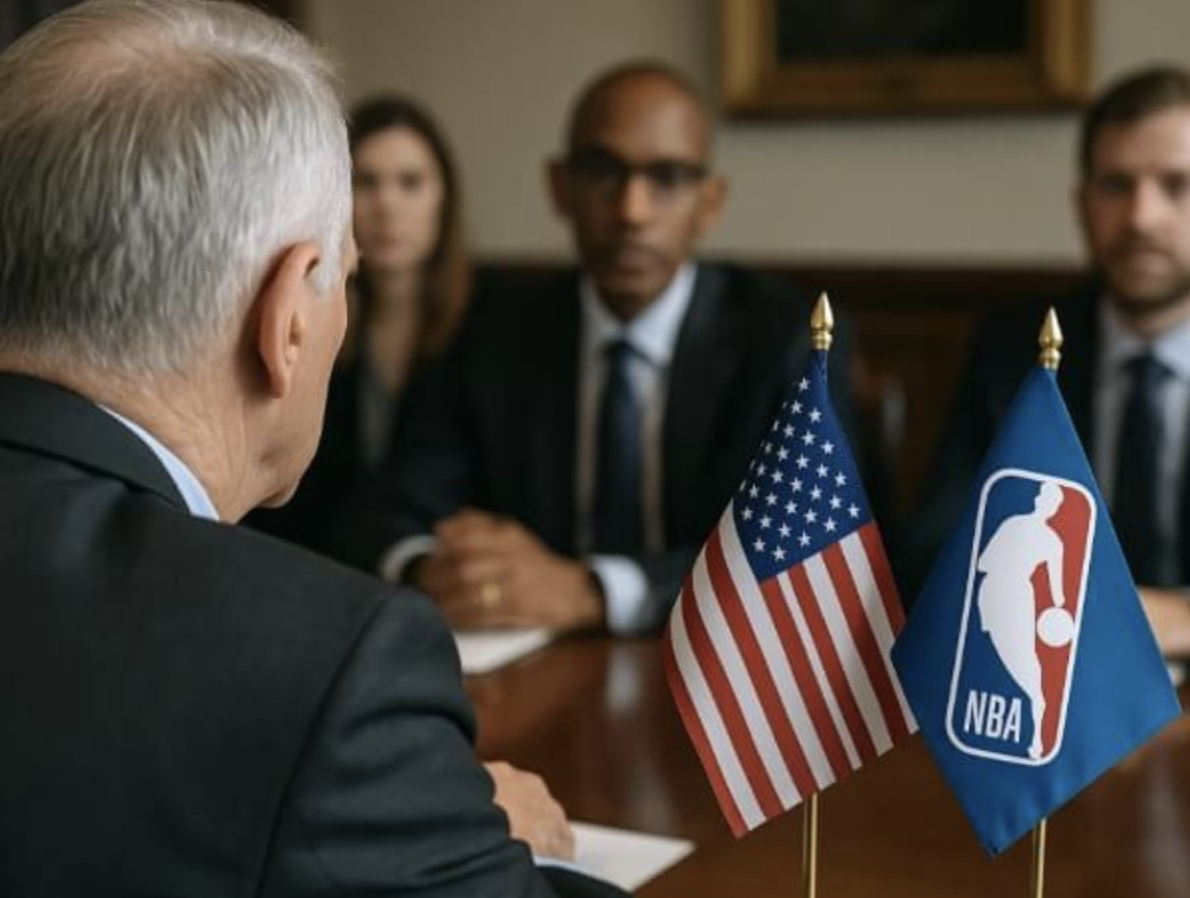
Photo via IGamingToday
***
Every institution eventually faces the same choice: fix the problem or fix the appearance of the problem. The NBA, to its credit, has been refreshingly transparent about which one it is doing. One third of the league is actively tanking—losing games deliberately in pursuit of a higher draft pick—and Commissioner Adam Silver has responded with fines, investigations, and emergency proposals that ultimately amount to nothing. If we continue to wait for our other institutions to be this honest about their intentions, we will be waiting for a long time. It’s about time we called it what it is.
One third is actively trying to lose games in hopes of obtaining a higher draft pick in an unusually loaded draft class in increasingly hilarious fashions. Jusuf Nurkić, a starting center for the Utah Jazz who averages a respectable 10.9 points per game on the season, was deemed too influential to team success and was ruled out for the season because of a severely deviated septum. Unless he’s a wannabe Kardashian, nobody schedules a nose surgery in the middle of an NBA season.
Leading the Golden State Warriors by one, the Sacramento Kings intentionally fouled Stephen Curry, a career 86.4% free-throw shooter, to send him to shoot two free throws with three minutes left in the game. The decision was so bizarre and consistent with tanking techniques that Warriors player Draymond Green said, “[…] fine the hell out of people” after the Warriors took home the win. After a week-long investigation, the league determined the decision was made purely out of incompetence, making the Kings the laughing stock of the league. While tanking seems to be an insignificant issue that exposes both crooked and unprofessional teams, the NBA sees it as an emergency.
Since January, the NBA has been scrambling to contain tanking and, most importantly, preserve the perception of the league and its competitive balance. In a series of meetings that felt like they had the sincerity of the Yalta Conference, Silver and team owners deliberated and eventually proposed three comprehensive solutions to address the problem. Each, varying in complexity and length, ultimately amounts to nothing.
There’s a reason why the league has kept punishments to fines, which amount to nothing more than a slap on the wrist for the league’s multi-billionaire owners. The NBA does not and will never care about losing; bad teams have always existed. What Silver cannot survive is the visibility of it. When it’s paired with the environment in which he is trying to expand the NBA to 32 teams, it becomes an issue. Recent estimates put the price of an expansion team at around $8 billion. If Silver can’t resolve the optics of tanking, he cannot sell those franchises and move forward with expanding the league. So if he can clean up the image and collect the check, he will have done his job. He doesn’t care about what the fans think. He cares about what the owners think, period.
People assume that the pathologies of sports leagues—tanking, losing, the slow degradation of competitive integrity—are reserved for athletes and the arenas they play in. And while I have no love lost for the NBA and its wholesale sellout to multi-billion dollar sportsbooks, the lessons from this particular moment are worth noting. Because in politics, the performance of fixing something is often the goal rather than the actual fix.
The most frustrating example of this is the repeated attempt to address insider trading in Congress. Both parties and independents can agree that using knowledge gleaned from public office to increase your own bottom line is unethical and should be illegal. The Stop Trading on Congressional Knowledge Act, signed in 2012, supposedly prohibits members of Congress, their staff, and federal officials from using non-public information for private profit. It mandates disclosure to increase transparency. And yet the penalties for non-compliance are weak, rarely enforced, and amount to little more than a parking ticket for people who have demonstrated a remarkable ability to beat the market.
Members of both parties recognize this. And yet after years of buildup, the solution on offer is the Stop Insider Trading Act—the same bill dressed up in a different costume. Democrats called it riddled with loopholes. One ranking member said it had gaps you could fly a Qatari jet right through—a pointed allusion to the Boeing 747 President Trump accepted from the Arab nation. Democrat leadership, for their part, have said they’ll only support a comprehensive bill if it targets the president as well, knowing full well that the bill would be dead on arrival at the White House. The NBA saw tanking becoming a bad look and moved to address it. Congress saw insider trading becoming a bad look and did the same thing. The difference between the two is negligible.
Tanking isn’t reserved for sports teams—political parties can do it too. In the late 2010s, the Labour Party was at a crossroads. The membership had swung hard left behind Jeremy Corbyn, a lifelong socialist who had spent decades at the fringe of British politics before an unlikely leadership run landed him in charge of one of Britain’s two major parties. The establishment wing of the party wanted nothing to do with him and began working actively to undermine the party’s 2017 campaign. Anti-Corbyn staff refused to share information with the leader’s office, directed resources to right-wing candidates, and, perhaps worst of all, came into the office to do nothing but text each other for several months. While these tactics did not immediately pay dividends with the Labour party taking a modest defeat, the anti-Corbyn wing were eventually rewarded for their efforts as the Labour party suffered its worst defeat since 1935 and Corbyn being forced to step down from leadership. Keir Starmer, a far more centrist candidate, took power and has not relinquished it since. Although this summary glosses over quite how unpopular Corbyn was in the late 2010s, it is irrefutable that members of his party made significant efforts to ensure he remained that way. The loss was not a failure. It was the product.
Authoritarians understand the power of appearances better than anyone. Russian President Vladimir Putin has won five presidential elections since 2000, each one more choreographed than the last. In 2024, Putin claimed over 87% of the vote in an election where his most prominent opponent, Alexei Navalny, had died weeks before a single ballot was cast. Boris Nadezhdin, the only explicitly anti-war candidate, was disqualified for not obtaining the required 100,000 legitimate signatures. The remaining candidates were all Kremlin-approved placeholders, none of whom broke 4%. With dissent to his campaign in Ukraine growing, Putin has meticulously isolated anti-war activists and crafted his image of infallibility despite cracks in the foundation.
Hungarian Prime Minister Viktor Orbán’s loss earlier this month marks something more significant than a typical incumbent defeat. For sixteen years, Orbán had perfected the art of a controlled democracy. He transformed his political allies into media oligarchs, placed 80% of Hungarian media market resources under his thumb, and built a political machine so dominant the opposition could not find its footing. The votes were real, and the result was never really in question.
Then the economy stopped working. Growth stalled, inflation surged, and jobs evaporated. The cost-of-living crisis began to hollow out the loyalty of millions of Hungarians that had tolerated Orbán’s consolidation of power as long as their lives were getting better. When that stopped, the game was up. United States Vice President J.D. Vance flew into Budapest in a desperate attempt to save a key Trump ally in Europe, an endorsement about as helpful as a Theranos blood test. Orbán attempted to recapture the youth’s support to no avail; his Fidesz party suffered a crushing loss in an election with record-breaking turnout.
This is what happens when performance fails. Putin’s elections work because enough Russians either believe or comply. Orbán’s worked for sixteen years because enough Hungarians accepted managed democracy in exchange for economic stability. Authoritarianism does not ask for your enthusiasm. It just asks for your exhaustion. Orbán had it for sixteen years. One Sunday, he didn’t anymore. The fight is nowhere near finished, but Hungary is a reminder that the performance, however convincing, however well-funded, however long-running, eventually has to face an audience that has nothing left to lose.
***
This article was edited by Olivia Fiorenza and Andrea Velez.
 Glenmarie Rios Rodriguez
  Sarah Olivia Sullivan
  Luke Helmholz