
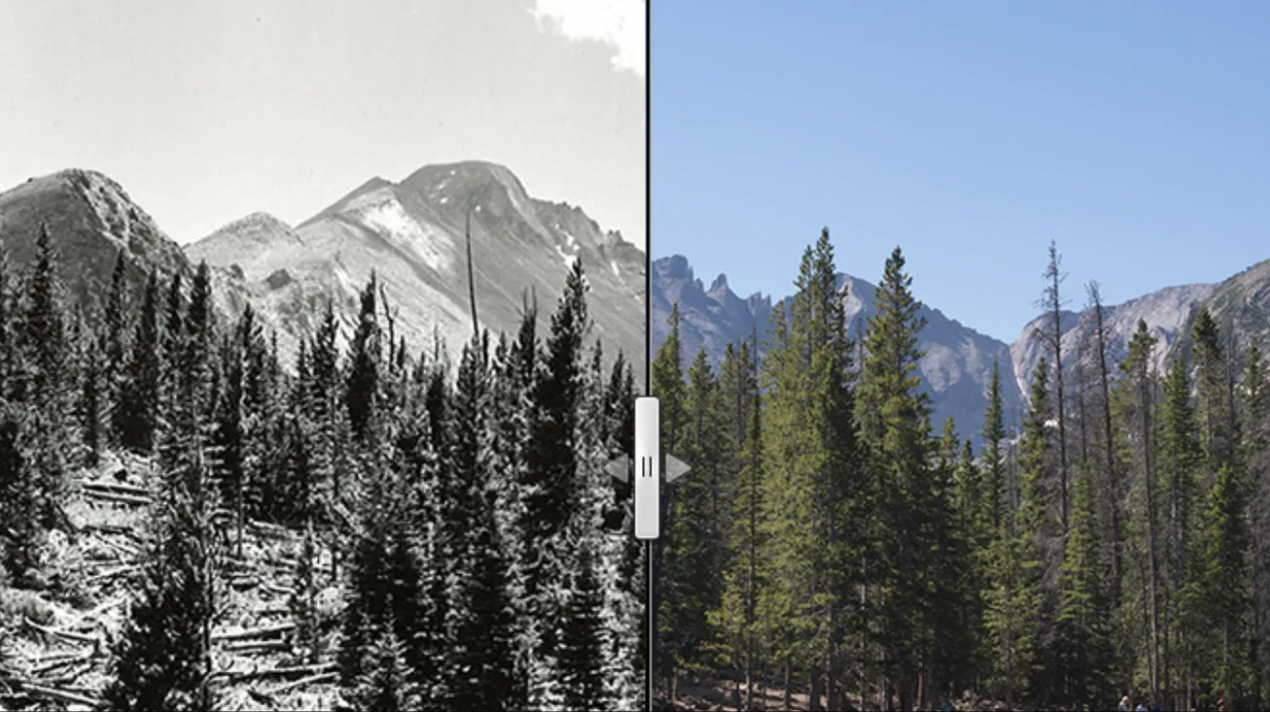
Photo via Coloradoan Archives (left) and Austin Humphreys (right)
***
The Colorado River supplies water for 40 million people across seven U.S. states and Mexico. This summer, the snowpack that usually tops the Rocky Mountains and feeds that river is scarce, as the American West experienced its warmest winter on record, and many of these states were already in a drought. These conditions are not an anomaly—they are a warning. As droughts become more frequent and severe, the American Southwest is being forced to confront not just environmental limits, but decades of political failure that have left the region unstable and exposed.
We have been taught that water is an abundant, renewable natural resource, but its availability depends entirely on how quickly we use it. Water from snow or rain flows through the water cycle comparatively quickly; lakes and rivers take decades, and water trapped in glaciers can take thousands of years to cycle through the system. When we use water faster than it can replenish, we put ourselves at serious risk of shortages. This is what the Southwest is currently facing—and, as global warming worsens, these conditions will only become more common. The issue is not simply that water is scarce, but that our systems for managing it have failed to account for the worsening scarcity.
Despite being the “water world,” only 2.5% of all Earth’s water is fresh. 69% of that is largely inaccessible in glaciers, leaving only 30% as groundwater and 1% surface water. Because of this strained resource, 2.1 billion people lack access to safe drinking water—an issue that disproportionately burdens women, preventing them from work, school, and caretaking as they often bear the primary responsibility for water collection. The surprising and frustrating element of the water crisis is that many countries, especially in sub-Saharan Africa, have groundwater basins but lack the infrastructure to extract and safely manage that water. According to the United Nations, inadequate water supply, sanitation, and water-related hygiene causes approximately 3.5 million deaths every year. Many of these deaths could be prevented with existing technology and tools, yet the issue continues year after year. In many cases, water scarcity is not a question of absolute supply, but of access, infrastructure, and governance.
I first learned about water scarcity in fourth grade when I read Linda Sue Park’s A Long Walk to Water, and I have since been very concerned about the United States’ silence on water conservation. The book follows the true story of Salva Dut, who survived the Second Sudanese Civil War and became part of the “Lost Boys of Sudan” in 1985. His journey is intertwined with Nya, a girl in 2008 who struggles daily to access water. I had the privilege of meeting Salva at a school fundraiser for his nonprofit, Water for South Sudan. Though I was naive and could do very little, I learned that the lack of access to water is terrifying and constant for much of the world. What once felt like a distant crisis is now a domestic reality, yet the United States has been slow to treat it with the urgency it demands.
Most of us in the United States do not feel any significant strain. In much of the country, you can walk into any building and turn on a faucet with clean, clear water. However, our water use is excessive. The average American uses 156 gallons of water per day. Simultaneously, we are actively limiting our supply with pollution, such as abandoned acid mine drainage and agricultural runoff, the new pressure created by data center water usage for cooling, and ‘dead zones’ caused by runoff from nutrient-rich soil that causes an algae bloom in the Gulf of Mexico and depletes the oxygen. These instances make it impossible for marine life to survive, causing the collapse of fisheries. America’s patterns clearly reflect unsustainable consumption that current policymakers have failed to meaningfully address.
All of these factors are putting the United States, particularly the American Southwest, at risk of water scarcity. Since the ratification of the Colorado Constitution in 1876, water management has remained critical in the region. Although the water levels can fluctuate drastically, the Colorado River remains a vital resource, feeding into smaller waterways and supplying water to Colorado, New Mexico, Utah, Wyoming, Arizona, California, and Nevada. It irrigates 5.5 million acres of farmland, generating $1.4 trillion in annual economic value. To put it simply, the Colorado River is incredibly important–yet it has been unfailingly over-allocated and strained beyond its natural limits.
The Colorado River Compact, signed in 1922, and a treaty with Mexico written and revised since 1944, divided access to the river among states and nations at a time of unusually high water levels. Since then, cities like Phoenix, Las Vegas, and parts of California have flourished economically, growth that would have been impossible before. However, these water rights were created under flawed assumptions about long-term water availability. As climate conditions shift, these legal agreements have become a source of conflict rather than a foundation of stability. Water rights are complex and have sparked extensive legal debate, especially during droughts. The conflicts will only grow more severe as resources continue to diminish.
With the warm weather in the West this past winter, the Southwestern United States is at serious risk of water shortages. Summer temperatures have generally increased year after year, and meteorologists have already predicted that North America will likely have a hotter, drier summer than normal. Snowpack levels are below average across the Rockies, exacerbating the problem further. Many of the cities in this region already have plans in place for water conservation and recycling, and those systems will be put to the test by the extreme weather conditions ahead. The upcoming summer will be challenging for local leaders, but it will also be a test of how well current policies hold up to the realities of a changing climate.
The policies are perceived as restricting water usage for millions of people, tapping into reserve aquifers that have been stored for years, and using water only when necessary. These measures are effective and have been implemented before, but they are ultimately temporary solutions. The water regulations will become more common, and with that, reliance on stored water will not be sustainable. The increasing dependence on emergency measures reveals that long-term planning has not kept pace with long-term risks.
American water conditions foreshadow what could happen worldwide as warm winters and prolonged droughts become more common. Many climate change deniers claim that the effects of global warming are distant, minor, or actually positive. But the consequences of our careless resource management are catching up to us, and many regions are not ready. Corpus Christi, a city in South Texas, has recently announced that it is at risk of completely running out of its water reserves this summer, without a comprehensive plan in place. The Ogallala Aquifer in the Central United States, which supplies much of the water for Midwestern agriculture, is at risk of drying up in the next 10-20 years and would take up to 6,000 years to replenish. The belief that climate change is a problem for future generations is being disproven in real time.
As water scarcity becomes more common, we will need to develop more robust strategies to mitigate its effects and reduce our environmental strain. Phoenix has been developing and planning water management programs for more than 117 years. The city recycles nearly 100% of its wastewater and uses diverse water-conservation methods to avoid over-reliance on a single system. Despite its ongoing drought, Phoenix is better prepared for increased water scarcity than many other cities. Its approach demonstrates that planning and multifarious methods can reduce vulnerability, even in high-risk areas.
Climate change is, at its core, a water crisis that impacts societies through floods, rising sea levels, shrinking ice sheets, wildfires, and droughts. Its effects will be widespread and felt by every person on Earth, and wealth will continue to determine who can shield themselves from the worst of it. As we have already seen in legal battles over water rights, access to water can drive domestic and global conflict. Debates have already begun over proposals to divert water from the Great Lakes to supplement the Southwest’s needs, reflecting just how strained our current systems have become.
The crisis unfolding in the Southwest is not inevitable; it is the result of choices. Policymakers have poorly regulated water access and conservation systems, leaving us vulnerable. Water might finally be the breaking point that compels politicians to act. How politicians respond to this threat in the coming years will likely determine how we fare in the reckless experiment we have made for ourselves. If meaningful action continues to be postponed, water scarcity will not be merely isolated events but instead may very well become one of the defining political moments of the 21st century.
***
This article was edited by Isabel Adkins and Georgie Javier.
 Glenmarie Rios Rodriguez
  Sarah Olivia Sullivan
  Luke Helmholz