
Photo via Harvard ReVista
***
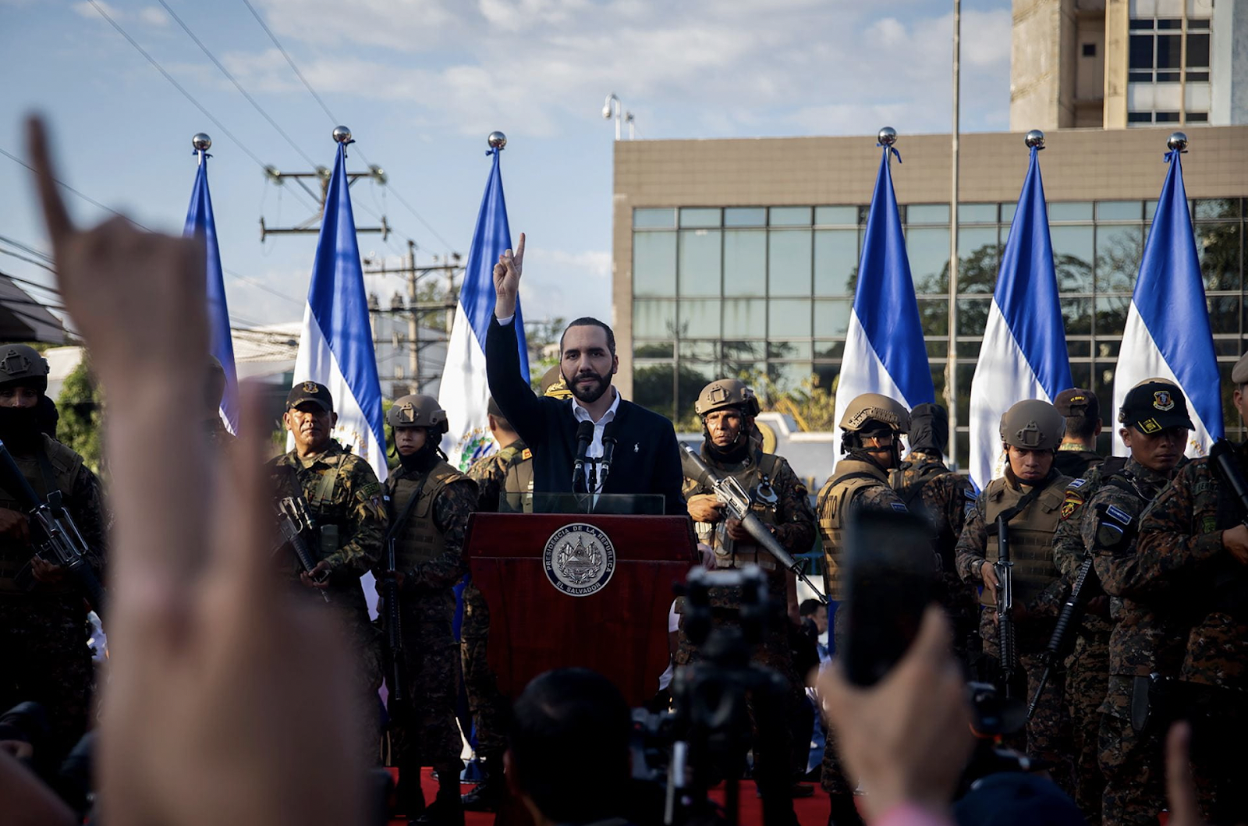
“Everywhere, people want a Bukele,” says Vice President Félix Ulloa of El Salvador; and it’s not hard to see why.
During President Bukele’s tenure, El Salvador has been transformed. The former murder capital of the world has seen an 80% decrease in homicides, thanks to his declaration of a state of emergency and crackdown on gang violence. The country’s economic growth has been stunning: it is adapting to the use of Bitcoin, garnering significant foreign investment, and being praised by the International Monetary Fund (IMF) for “expanding at a faster than anticipated pace on the back of improved confidence, record remittances, and buoyant investment.” El Salvador’s future is bright, and its present position is hopeful—with some notable exceptions.
“Everywhere, people want a Bukele,” Vice President Ulloa insisted. “Where?” questions Cecilia Ballesteros, a journalist for Spanish newspaper El País. “Latin American history is full of strongmen, of caudillos. This trend appears to be returning. Isn’t there a danger that the new leaders will be very similar to the old dictators?” Ballesteros asks.
There’s no exact translation for caudillos, but they are best described as a group of militaristic, personalistic leaders most prevalent in 19th-20th century Latin America. Their legacy of machismo authoritarianism was carried on by figures like Fidel Castro, Juan Perón, and now, in what some experts are calling an “age of zombie democracies” (or democracies in name only), Nayib Bukele.
Bukele is currently serving his second term in a country that once constitutionally forbade presidential reelection. He was elected in 2019, saw a supermajority form across the branches of government in favor of his party Nuevas Ideas, then passed a constitutional amendment in 2021 which allowed for reelection, and dismantled any consistency in term lengths.
In March of 2022, Bukele requested that his legislature declare a 30-day state of exception to combat the crisis of gang violence. Over 4 years later, in April of 2026, El Salvador remains under a state of exception, which legally suspends “freedom of association, the right to be informed of the reasons behind detention, the right to defense or freedom from testifying against oneself, limits on length of detention, and protections of private correspondence.” Since its enactment, over 85,000 people have been detained; El Salvador now has the highest incarceration rate in the world, and many of these prisoners have been arrested without proper trial (mass trials have been used to convict large groups of people at a time) or knowledge of the reason for their arrest. “Young people [are] arrested because an agent said they looked nervous; neighbors accusing neighbors of gang ties; cab drivers denouncing their competitors to get rid of them; men arrested for competing with a policeman over the love of a woman. That’s how the quotas get filled. Police officers extorting money from innocent people in exchange for not taking them away,” explains Carlos Dada, co-founder of El Faro, a Salvadoran newspaper exiled to Costa Rica for criticizing the government.
Even economically, success has not been as advertised. Development has been focused on modernizing city centers, building new ones, and adding high-tech ports to accompany them. Bukele’s aim to generate revenue by attracting foreign business and tourists has led to shallow growth, and neglect of El Salvador’s rural majority. When national progress is only felt by the most fortunate of a country, how can it really be called progress? In addition, a large amount of the country’s capital comes from remittances: payments from those who immigrate to the United States, sent back to their families in El Salvador. Remittances make up approximately 25% of the country’s Gross Domestic Product (GDP). And as the southern US border becomes an area of more and more peril, increasing remittances can no longer be called a sure thing.
In an attempt at innovation, Bitcoin was made a national legal currency alongside the US dollar in 2021. To promote use, the government offered a $30-equivalent incentive for downloading the country’s sponsored Chivo Wallet (loosely translated to Cool Wallet). However, studies found that most Salvadorans immediately converted the Bitcoin to dollars for use, or spent their bonus and deleted the app. Some argued that this was from a lack of knowledge—but Bitcoin experiments have existed in the country for years. Instead, surveys indicated that citizens did not trust the government’s app, and preferred the anonymity and practicality of cash.
This points to the fact that 66.5% of those employed in El Salvador work informally, for family or local unofficial enterprise. Though it is the backbone of the country’s working class, it does mean that many government-issued financial benefits often don’t reach them.
Of course, they have felt some of the safety benefits of Bukele’s presidency, as one of the most vulnerable groups to gang violence and extortion. “When you’ve lived with a gun to your head, security takes priority over constitutions and laws and democracy,” writes Dada. This is one of the assumed reasons for Bukele’s record-high approval rating, this and what El Pais asks in their interview of the Vice President; “You’re going to hold elections under a state of emergency. You’re a lawyer…how can anyone vote like that?” Thanks to this state of exception, a deep fear has been instilled in the Salvadoran public, that any dissent could lead to detention. Thus, Bukele’s biggest investment has been in his international image—building shiny new cities and silencing his opposition.
Despite all this effort, he has not pulled the wool over the eyes of the world.
Foreign nations and NGOs alike have raised red flags about the government of El Salvador—headed by a man who calls himself ‘The World’s Coolest Dictator.’ Though Bukele has modeled much of his personality-driven governance after US President Donald Trump, and the two leaders have cooperated in incarceration efforts, he can expect only support limited by the outcry of American civil society groups, President Trump’s dedication to tariffs, and increasing taxes on remittances. Though the IMF agreed to grant El Salvador a loan deal, it also questioned the national Bitcoin initiative, and is lobbying for a sale of the Chivo Wallet. The aforementioned Spanish interview with Vice President Ulloa descended into a skirmish over what democracy should truly be. Both Ulloa and Bukele have admitted that their style of governance isn’t a traditional democracy, at times allowing that it may not be democracy at all.
Potential investors have begun to read the fine print on agreements with Bukele.
And with further inspection, they’ll find that his ‘development’ has been shallow and centralized, with the problems of poverty not solved, but simply swept under the rug. And without foreign investment, it’s a certainty that whatever sparks in economic growth will be snuffed out. Even his success against gang violence bears the signs of illegitimacy, no matter how impressive. Yes, innocent civilians are better protected from gang violence, but innocent civilians are also being imprisoned without a reason. Injustice can never be solved with more injustice—no exceptions.
***
This article was edited by Abigail D’Angelo.
 Luke Helmholz
  Sidney Levitt
  Ayden Suber